The Galaxy S27 UFS 5.0 Upgrade is officially poised to be the most disruptive technological leap in the mobile industry for 2026. While the tech world has been obsessing over miniaturized processors, Samsung is quietly revolutionizing a completely different component.
For years, the specifications race in flagship smartphones has been dominated by the processor. Consumers have been conditioned to look for the newest Snapdragon or Exynos chip. However, an unexpected shift is occurring.
Samsung has faced heavy criticism recently for taking a backseat in the raw hardware race. Many Chinese competitors have aggressively pushed boundaries, leaving Samsung’s spec sheets looking somewhat conservative. That narrative is about to drastically change.
According to the latest industry murmurs, the true hero of the upcoming flagship will not be the processor. Instead, the company is preparing a monumental storage revolution. This massive leap will make the new lineup exponentially faster and more responsive than any previous generation.
A new 2nm chipset upgrade is certainly on the horizon. However, it is not the only, nor perhaps the most impactful, change buyers should look forward to next year. The introduction of next-gen UFS 5.0 storage is going to redefine our expectations of mobile speed.
Outshining the 2nm Hype: The Power of 10.8GB/s
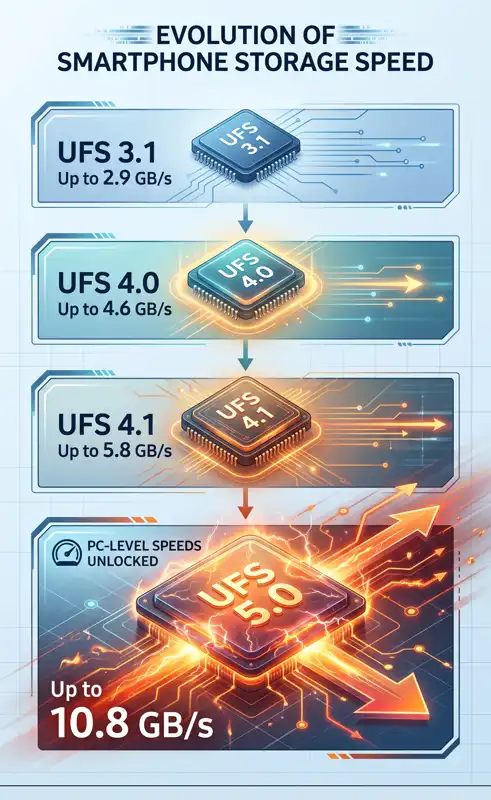
To understand the magnitude of this shift, we must look at where we are right now. At present, top-tier flagships, including the Galaxy S26 lineup, utilize up to UFS 4.1 storage. This standard already offers ridiculously fast read and write speeds.
However, Samsung isn’t just settling for incremental updates. The latest Galaxy S27 hardware leaks indicate that the Korean giant is skipping the gradual approach. They are fast-tracking the deployment of Universal Flash Storage 5.0.
Initially, industry insiders believed this technology would not be ready until late 2027. Samsung was reportedly still heavily focused on maximizing UFS 4.0 advancements. Yet, as AI demands escalated, the timeline was aggressively accelerated.
This acceleration is crucial. The governing body for microelectronics, the JEDEC Solid State Technology Association, has outlined that this new standard can deliver staggering speeds. We are talking about 10.8GB/s mobile flash memory.
This level of performance rivals the desktop-class PCIe NVMe Gen 5 standard. To put it simply, your smartphone will read and write data as fast as a high-end gaming PC. This means zero loading screens and instant app installations.
“The leap to UFS 5.0 is not just an upgrade; it is a paradigm shift that turns smartphones into pocket-sized supercomputers capable of rendering desktop-level workflows instantly.”
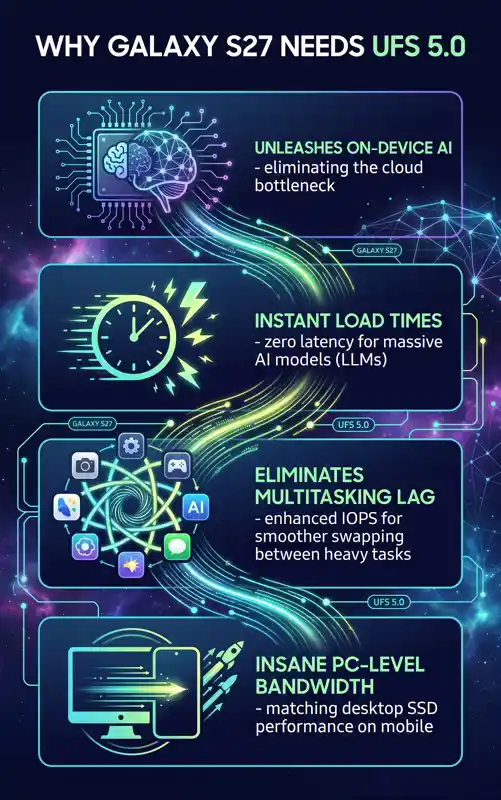
But raw sequential speed is only half of the equation. A smartphone’s snappiness is largely determined by its IOPS (Input/Output Operations Per Second). High IOPS allows the device to juggle thousands of tiny background tasks simultaneously.
When you switch rapidly between a heavy game, a 4K video editor, and your camera, it is the IOPS that prevents the phone from stuttering. The Galaxy S27’s storage will feature dramatically higher IOPS, ensuring the entire device performs tasks in the literal blink of an eye.
| Storage Standard | Max Bandwidth | Primary Device Integration |
|---|---|---|
| UFS 3.1 | Up to 2.9 GB/s | Galaxy S22 Series |
| UFS 4.0 | Up to 4.6 GB/s | Galaxy S24 Series |
| UFS 4.1 | Up to 5.8 GB/s | Galaxy S26 Series |
| UFS 5.0 | Up to 10.8 GB/s | Galaxy S27 Ultra (Rumored) |
The Critical Role in On-Device AI Smartphone Performance
Why the sudden rush to implement such extreme speeds? The answer lies entirely in artificial intelligence. The smartphone industry is pivoting hard toward native, offline AI capabilities.
Currently, many “AI phones” rely heavily on cloud processing. You ask your phone a complex question, it sends the data to a server, processes it, and sends the answer back. This causes noticeable latency and raises massive privacy concerns.
To fix this, manufacturers are pushing for on-device AI smartphone performance. This means the AI models (LLMs) must live directly on the phone’s internal storage. These models are incredibly massive, often spanning several gigabytes in size.
When you trigger an AI feature, the phone must instantly load these massive datasets from the storage into the RAM. Current UFS 4.0 and 4.1 standards are sufficient for basic AI operations, like translating text or summarizing a short note.
However, Samsung has grander ambitions for 2026. To truly accelerate plans to offer a closer, instantaneous on-device experience, standard storage simply creates a bottleneck. The processor ends up waiting for the storage to deliver the data.
This is where the new storage technology becomes mandatory. It ensures that massive AI models are fed to the 2nm chipset without a millisecond of delay. This results in real-time video generation, instant complex image editing, and seamless voice interactions.
Capacities, the DRAM Crisis, and the Ultra Exclusive
Despite the revolutionary speed, there might be a slight catch regarding storage sizes. Industry analysts point out that due to an ongoing global DRAM crisis, memory manufacturing costs have skyrocketed.
Because of these supply chain constraints, Samsung’s original plans for massive base storage capacities may not reach fruition. It is highly probable that the Galaxy S27 family will debut with 256GB of upgraded memory as the baseline.
While 256GB will be considered adequate for the majority of buyers, power users might feel the pinch. The sheer size of high-resolution video and massive on-device AI packages will eat up space rapidly. Users will need to carefully manage their digital libraries.
“The true test of the S27 series will not just be its hardware, but whether Samsung’s software can fully leverage the immense bandwidth that UFS 5.0 provides.”
Furthermore, early whispers regarding the Samsung Galaxy S27 Ultra specs suggest this bleeding-edge technology might be heavily gated. Implementing UFS 5.0 is expensive and requires highly complex motherboard designs to manage the heat generated by such fast data transfers.
If Samsung goes through with the timely development of this storage, at the very least, we should see it arrive primarily in the Ultra model. The standard and Plus models might retain a highly optimized version of UFS 4.1 to maintain competitive pricing.
| Rumored Galaxy S27 Model | Expected Storage Tech | Base Capacity |
|---|---|---|
| Galaxy S27 (Standard) | UFS 4.1 | 256GB |
| Galaxy S27 Plus | UFS 4.1 / UFS 5.0 (Mixed) | 256GB |
| Galaxy S27 Ultra | UFS 5.0 Exclusive | 256GB / 512GB |
Software: The Final Piece of the Puzzle
Having the fastest storage on the planet is pointless if the operating system cannot utilize it. More important than the physical hardware is the underlying software required to leverage UFS 5.0 storage fully.
Samsung’s One UI will need a massive architectural overhaul. The file system must be optimized to handle PC-level data streams without crashing or causing thermal throttling. We expect to see deeply integrated programs designed specifically to exploit this new bandwidth.
If executed correctly, the user experience will be unprecedented. Apps will not “load”; they will simply appear. Switching between intense tasks will feel frictionless. The reliance on the cloud will plummet, giving users unparalleled privacy and speed.
As we approach 2026, the hype around nanometer processor nodes will inevitably continue. But informed tech enthusiasts know the real bottleneck has always been storage. By breaking this barrier, Samsung is setting a new gold standard for the entire smartphone industry.
The next generation of mobile devices will not be defined by how fast they calculate, but by how fast they recall information. In that arena, the upcoming Galaxy flagship seems entirely unmatched.
Frequently Asked Questions
What exactly is the UFS 5.0 upgrade coming to the Galaxy S27?
It is a next-generation flash memory standard that dramatically increases the speed at which the phone can read and write data, reaching up to 10.8GB/s, effectively matching high-end PC storage speeds.
Why is UFS 5.0 better than the highly anticipated 2nm chipsets?
While a 2nm chip calculates data incredibly fast, it often has to wait for data to load from storage. UFS 5.0 eliminates this bottleneck, feeding massive amounts of data to the processor instantly, resulting in a significantly snappier real-world feel.
How will this new storage improve AI features on the phone?
Advanced on-device AI requires loading massive language and image models into memory instantly. The extreme bandwidth of the new storage allows these multi-gigabyte AI models to execute in real-time without relying on slow internet connections.
Will all Galaxy S27 models get the new UFS 5.0 storage?
Current hardware leaks suggest it might be an exclusive feature for the top-tier Galaxy S27 Ultra, due to high manufacturing costs and thermal management requirements, while the base models may stick to optimized UFS 4.1.
Is the base storage capacity increasing for the S27 lineup?
Likely not. Due to a global DRAM crisis driving up memory costs, rumors indicate the base storage will remain at 256GB, though the speed of that storage will be vastly superior to previous generations.
What does IOPS mean, and why does it matter for my phone?
IOPS stands for Input/Output Operations Per Second. It measures how many small tasks the storage can handle at once. High IOPS means your phone will not freeze or stutter when you have dozens of apps open or are rapidly switching tasks.
When is the Samsung Galaxy S27 expected to be released?
Following Samsung’s traditional release cycle, the Galaxy S27 lineup is expected to be officially unveiled and released in the first quarter of 2026.
Disclaimer: This article is for informational purposes only. The specifications, hardware details, and timelines discussed regarding the Galaxy S27 and UFS 5.0 storage are based on industry leaks and rumors available as of 2026. Official features and release dates are subject to change by Samsung.