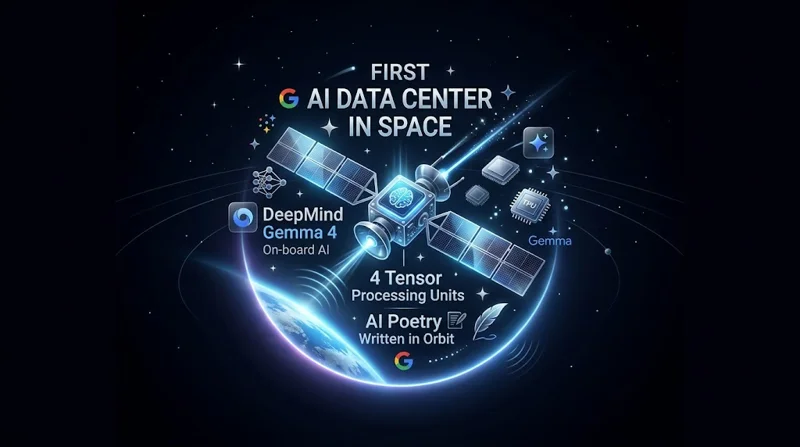
Googles first data center satellite is online and writing poetry, marking a massive milestone in aerospace and artificial intelligence in 2026. The Google Suncatcher prototype has officially commenced operations, communicating with ground control after its successful deployment. This historical launch occurred earlier this month, riding alongside more than 100 other spacecraft on a powerful SpaceX Falcon 9 rocket.
The concept of placing server farms into low Earth orbit has moved from science fiction to reality. As orbital AI inference workloads demand more innovative solutions, this mission serves as a critical testbed. The fact that Googles first data center satellite is online and writing poetry proves that complex AI models can successfully run in the harsh environment of space.
The Historic Moment: Googles first data center satellite is online and writing poetry
After a rigorous three-week commissioning process to test the spacecraft’s subsystems, the satellite was finally ready for real work. Engineers on the ground sent their very first prompt to the DeepMind Gemma 4 model, which was pre-loaded onto the hardware. The prompt was simple: write a haiku about being in space.
The result was a stunning, eerie, and poetic response generated entirely in orbit. It successfully demonstrated that the Google Suncatcher space satellite is fully capable of processing advanced AI commands from hundreds of miles above the Earth’s surface.
Blue marble below
Data streams in silent grace
Starlight feeds my core. ✨
Following this successful test, a spokesperson confirmed that the spacecraft is operating nominally. The company also requested the model to report on local orbital conditions. This is a massive leap forward for deploying scalable data infrastructure in orbit. You can learn more about these advanced AI models directly from the official Google DeepMind research portal.
| Satellite Specification | Technical Details |
|---|---|
| Hardware Onboard | Four Google Tensor Processing Units (TPUs) |
| Power Generation | Up to 1 kW of electrical power |
| AI Model Used | Google DeepMind Gemma 4 |
| Launch Vehicle | SpaceX Falcon 9 rocket |
Hardware Limits While Googles first data center satellite is online and writing poetry
Despite the incredible success of this launch, there are massive technical hurdles to overcome. The satellite carries four Google Tensor Processing Units (TPUs), but power generation remains a severe bottleneck. The spacecraft generates a maximum of 1 kW of electricity, meaning it cannot run all of its hardware continuously.
In fact, the immense power demands of the TPU mean that engineers can only turn one on for about 20 minutes at a time. This power limitation severely complicates the already tricky business of space-to-ground communications. Managing these power cycles is a primary focus for the engineering team now that Googles first data center satellite is online and writing poetry.
Radiation Testing Since Googles first data center satellite is online and writing poetry
The ongoing test campaign will carefully examine how these highly advanced chips perform under extreme thermal stress. Furthermore, the space radiation environment presents a unique threat to orbital AI inference workloads. Google has tested TPUs in particle accelerators on Earth, but nothing mimics the true vacuum of space.
Space radiation bit flips are a major concern. Radiation can cause a stored value in computer memory to spontaneously flip, which in turn can corrupt valuable data without triggering typical monitoring tools. This makes the current mission absolutely essential for future designs.
“Radiation can cause bit flips in computer memory, corrupting data silently. Real-world testing in orbit is the only way to safeguard future space-based AI networks.”
By observing these effects firsthand, developers can design better shielding and error-correction algorithms. This will pave the way for massive, interconnected networks of close-flying satellites that can handle heavy cloud computing tasks from space.
| Orbital Challenge | Impact on the Satellite |
|---|---|
| Power Constraints | Limits TPU uptime to just 20 minutes per session. |
| Cosmic Radiation | Induces bit flips that silently corrupt memory data. |
| Thermal Stress | Extreme temperature swings can degrade processing hardware. |
The Future Impact of the Google Suncatcher Space Satellite
As we look to the future, it is clear that humanity is entering a new era of decentralized, off-planet computing. The success of this prototype proves that the foundational technology works. As engineers gather more data, subsequent iterations will undoubtedly feature better power management and radiation hardening.
It is truly an exciting time for technology. Knowing that Googles first data center satellite is online and writing poetry gives us a glimpse into a future where the cloud physically resides among the stars.
Frequently Asked Questions

What did the Google Suncatcher satellite do in space?
It successfully booted up, communicated with Earth, and used the DeepMind Gemma 4 AI model to write a haiku about being in space.
Is it true that Googles first data center satellite is online and writing poetry?
Yes, the prototype space data center is officially online and successfully generated a space-themed haiku during its first operational test.
What kind of processors are onboard the satellite?
The spacecraft carries four highly advanced Google Tensor Processing Units (TPUs) designed to handle intensive AI workloads.
Why can the satellite only run its processors for 20 minutes?
The satellite generates a maximum of 1 kW of electricity, meaning it does not have enough power to run the highly demanding TPUs continuously.
What are space radiation bit flips?
Space radiation can strike computer memory and cause a bit to flip from a 0 to a 1 (or vice versa), which silently corrupts data without triggering standard error monitors.
How was this prototype satellite launched into orbit?
It was launched into space earlier this month aboard a SpaceX Falcon 9 rocket, riding alongside more than 100 other spacecraft.
What is the long-term goal of this project?
The ultimate goal is to create large networks of close-flying satellites that can perform massive AI inference workloads directly in orbit, offloading power demands from Earth.
Disclaimer: This article is for informational purposes only, and we are not affiliated with any technology, aerospace, or governmental institution mentioned.