The reality of the DJI Osmo Pocket 4 ban has finally hit American content creators hard in 2026, marking a historic shift in the technology and camera landscape. What was supposed to be the most exciting vlogging camera release of the year has instead become the first major casualty of escalating geopolitical tech wars.
DJI’s latest pocket-sized powerhouse made its global debut today. It looks like a phenomenal upgrade to the Pocket 3, which has long been the top-rated camera for YouTube creators, TikTokers, and professional videographers alike. However, American consumers will not be able to purchase it.
Because the Osmo Pocket 4 did not secure FCC authorization before DJI was officially added to the government’s highly restrictive Covered List, it is legally blocked from being sold or imported into the United States. This marks a turning point where consumers are directly feeling the sting of the US government’s broad tech sanctions.
The Launch: What the US Market is Missing
To understand the frustration surrounding the DJI FCC ban, we have to look at what the Osmo Pocket 4 actually brings to the table. DJI did not reinvent the wheel, but they polished it to an absolute shine.
The Pocket 4 maintains the beloved handheld form factor that made its predecessors so successful. It keeps the massive Type 1 image sensor size, ensuring incredible low-light performance, and retains the industry-leading 3-axis mechanical gimbal stabilization.
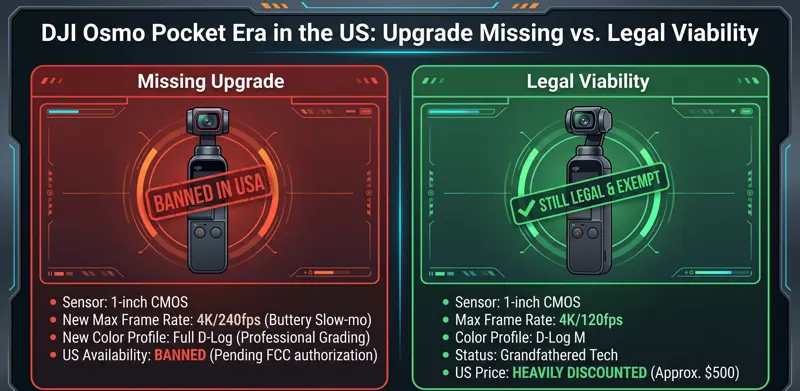
Where the Pocket 4 truly shines is in its evolutionary upgrades. The new model doubles the fastest frame rate, allowing creators to shoot in stunning 4K240 for buttery smooth, dramatic slow motion. This is a massive leap for a camera of this size.
Furthermore, DJI improved the camera’s flat color profile. They upgraded it from the Pocket 3’s D-Log M to a full D-Log recording format. This seemingly small change leaves significantly more room for professional color correction and cinematic grading in post-production.
| Feature | DJI Osmo Pocket 3 | DJI Osmo Pocket 4 |
|---|---|---|
| Sensor Size | 1-inch CMOS | 1-inch CMOS |
| Max Frame Rate (4K) | 4K / 120fps | 4K / 240fps |
| Color Profile | D-Log M (10-bit) | Full D-Log (10-bit) |
| US Availability | Available (Exempt) | Banned (FCC Covered List) |
All in all, it is a remarkably solid upgrade. While it may be more evolutionary than revolutionary, it cements DJI’s dominance in the vlogging sphere. Unfortunately, the Osmo Pocket 4 US availability is practically zero.
The Political Context: Why is DJI Banned?
The road to this unprecedented ban was paved with years of political maneuvering and national security concerns. The writing has been on the wall for a long time, but many consumers ignored it until their favorite gadgets were directly affected.
In December of last year, DJI’s entire product line—including drones, gimbals, microphones, and cameras—was officially added to the FCC’s Covered List. This was not a sudden shock to industry insiders following the legislative trail.
The catalyst was the 2024 National Defense Authorization Act (NDAA). This critical funding bill, passed by Congress and signed into law by then-President Biden, mandated a strict security audit of DJI’s product line. The deadline for this audit was set for December 2025.
The law stipulated a harsh penalty: if DJI failed the audit, or if no government agency bothered to complete it, DJI’s communications and video surveillance equipment would automatically be added to the FCC’s list of disallowed products.
The intersection of consumer technology and national security has created a landscape where the best tools are no longer determined by innovation, but by geopolitical borders.
As 2025 dragged on, it became painfully clear that no federal agency was actually dedicating resources to perform the mandated audit. DJI repeatedly put out public statements begging for the work to be completed to prove their security compliance.
However, the new Trump administration had vastly different priorities regarding foreign trade and technology. When the December deadline finally arrived, the FCC did not just enforce the letter of the law; they went well beyond the scope of the required changes.
The FCC’s Broad Strike
The FCC didn’t just add DJI’s current communications gear to the Covered List; they essentially enacted a blanket ban on all foreign-made drones and related surveillance tech from specific countries. You can read more about the legal framework directly on the FCC’s Covered List official portal.
There were a few caveats to this sweeping legislation. Equipment that had previously secured FCC approval was grandfathered in. This means your old DJI drones and older model cameras can still be legally used, bought, and sold on the secondhand market or by retailers clearing out old stock.
Additionally, specific carve-outs were made for drones explicitly approved by the Department of Defense. However, there is zero crossover between highly specialized military drones and consumer vlogging cameras. For content creators, real estate agents, and casual videographers, these military exemptions mean absolutely squat.
The First True Victim
Until today, everyday consumers haven’t truly felt the brunt of the FCC’s aggressive actions. DJI managed to push several of its first-quarter 2026 products through the grueling FCC approval phase just ahead of the Covered List changes.
Products like the highly anticipated Avata 360 drone, the Mic 3 wireless microphone system, and the heavy-duty RS 5 gimbal were all technically released in 2026. While DJI isn’t officially selling them directly through its own US-facing online store, independent retailers and third-party distributors are successfully filling the gaps for American customers.
But the story ends in a brick wall with the Pocket 4. According to official statements, DJI explicitly noted that the Osmo Pocket 4 will not be available in the US market at launch specifically due to pending FCC authorization.
In plain language, DJI submitted the Pocket 4 to the FCC for standard regulatory approval, but the agency dragged its feet and did not give the final okay before DJI was slammed onto the Covered List. Now, the device is stuck in regulatory purgatory.
Will the Ban Be Reversed?
Many creators are holding out hope that the FCC will eventually approve the Pocket 4, or that the ban will be entirely overturned. DJI is currently suing the US government over the ban, arguing it is unconstitutional and anti-competitive.
While a successful lawsuit could theoretically change the story, industry experts consider it highly improbable. The political climate in Washington is fiercely anti-foreign tech. Reversing a high-profile ban on a major Chinese tech company would require massive political capital that no one is willing to spend.
The FCC’s aggressive stance has already extended beyond drones and cameras, heavily restricting foreign-made Wi-Fi routers and telecom equipment. A voluntary walk-back by the government is practically impossible until entirely different administrations and agency heads are in power.
Creator Alternatives: Where Do We Go From Here?
So, what are US-based content creators supposed to do in the meantime? The vlogging industry relies heavily on lightweight, stabilized cameras. If you have been thinking about adding a Pocket-style camera to your video kit, you need a backup plan.
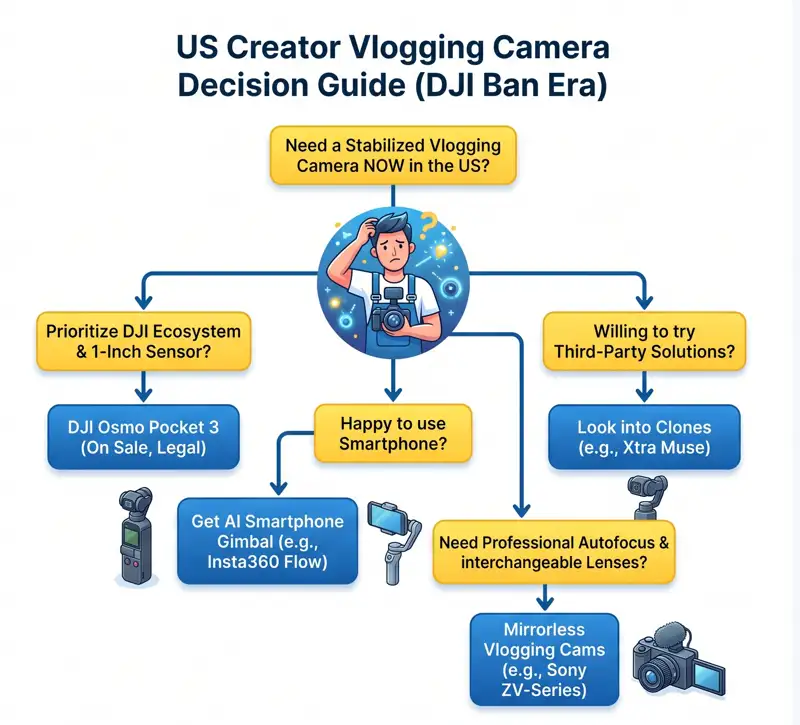
There is a massive silver lining in this frustrating situation: The Osmo Pocket 3 discount. Because the Pocket 3 was approved long before the ban, it remains perfectly legal to sell and use in the United States.
Currently, the Pocket 3 is still widely available and is selling for around $500. This is an incredible discount compared to its original $799 debut price. While the Pocket 4 is undeniably better on paper, the Pocket 3 remains an absolute beast of a camera.
| Alternative Camera | Best Feature | US Status |
|---|---|---|
| DJI Osmo Pocket 3 | 1-inch sensor, established reliability | Legal & Discounted |
| Xtra Muse | Nearly identical clone to the Pocket 3 | Available |
| Insta360 Flow (with Smartphone) | AI tracking, utilizes existing phone camera | Available |
| Sony ZV-1 II | Professional autofocus, dedicated vlogging mic | Available |
DJI appears highly committed to keeping their FCC-approved legacy gear in active production specifically to service the hungry US market. However, global supply chains are fragile, and there is no guarantee that the Pocket 3 will stick around forever. If you need one, pick one up while supplies last.
Adaptability is the greatest tool a creator possesses. When the hardware changes, the storytelling must evolve.
We will also have to keep a close eye on the secondary market and international clones. Manufacturers are already rushing to fill the void left by DJI’s absence. The Xtra Muse, for example, has recently hit the streets and looks like a literal, bolt-for-bolt clone of the Pocket 3.
While long-term durability remains untested, tech reviewers like ReadySetDrone have tried the Muse and described it as being “99% a Pocket 3” in terms of functionality and image output. It will be incredibly interesting to see if Xtra or other brands follow up with their own unauthorized takes on a Pocket 4.
If you are actively shopping for a video camera for YouTube, TikTok, and social media in 2026, you will have to look beyond the newest DJI models. The landscape has changed, but the demand for high-quality video creation has never been higher.
Frequently Asked Questions
Why exactly is the DJI Osmo Pocket 4 banned in the US?
The camera failed to receive FCC authorization before the government added DJI to the Covered List under the National Defense Authorization Act, making it illegal to import or sell new unapproved DJI equipment in the US.
Can I still legally use my older DJI cameras and drones?
Yes. Any DJI equipment that received FCC approval prior to the ban (like the Osmo Pocket 3 or older Mavic drones) is grandfathered in and perfectly legal to use and sell.
Can I buy the Pocket 4 in another country and bring it back to the US?
While individuals might sneak them across borders, the devices lack FCC certification, making their domestic use technically non-compliant with federal broadcasting regulations, and you won’t have access to US warranty or support.
Are there any good vlogging camera alternatives to the Pocket 4?
The DJI Osmo Pocket 3 is still available at a steep discount. Alternatively, creators are turning to clones like the Xtra Muse, or utilizing smartphone gimbals like the Insta360 Flow.
Will DJI’s lawsuit overturn the FCC ban?
Legal experts consider it highly improbable in the short term. The ban is rooted in bipartisan national security legislation, making a swift legal victory for DJI unlikely.
Did any 2026 DJI products make it to the US market?
Yes. The Avata 360 drone, Mic 3, and RS 5 gimbal secured FCC approval right before DJI was officially placed on the Covered List, allowing third-party retailers to sell them.
Does this ban affect military or law enforcement drone use?
The legislation includes specific carve-outs and exemptions for drones explicitly approved by the Department of Defense for official use, but this does not apply to consumer cameras.
Disclaimer: This article is for informational purposes only. The regulatory status of consumer electronics, international trade laws, and FCC regulations are subject to change. Please consult official government resources for the most up-to-date legal compliance information.