Core 7 360 is officially here, and it marks a massive turning point for budget-friendly laptops in 2026. Tech enthusiasts and casual users alike have been waiting to see how Intel would respond to the growing dominance of ARM-based silicon in the entry-level computing space.
The answer comes in the form of the newly announced Intel Core Series 3 mobile processors. Built on an entirely new die codenamed Wildcat Lake, this specific tier of silicon drops the “Ultra” moniker but packs a serious punch where it truly matters.
Intel’s primary target with this launch is crystal clear. The company is aiming directly at Apple’s highly successful MacBook Neo systems. By offering high efficiency and advanced AI capabilities at a lower price point, Intel is hoping to win back the hearts of budget-conscious creatives and students.
While official pricing details remain heavily guarded, the specifications alone suggest a highly aggressive strategy. We are looking at a chip that redefines what a non-premium laptop can achieve in terms of raw compute, graphics, and artificial intelligence tasks.
Understanding the Wildcat Lake Architecture Specs
To truly grasp the potential of this new processor, we have to look under the hood at the Wildcat Lake architecture specs. Intel has completely rethought its core distribution for this specific market segment.
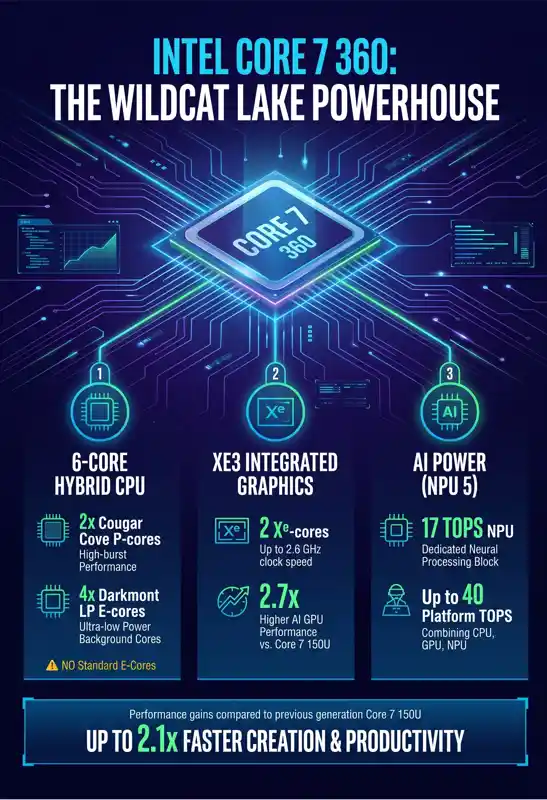
The new processor features a highly specialized 6-core CPU configuration. Unlike previous generations that flooded the spec sheet with numerous efficiency cores, this layout is lean and incredibly focused on task optimization.
The heavy lifting is handled by two powerful Cougar Cove P-cores. These performance cores are designed to burst rapidly, handling intensive foreground applications like video rendering, complex web applications, and sudden productivity spikes.
Complementing the performance tier are four Darkmont LP E-cores. The “LP” stands for Low Power, indicating that these cores are strictly designed to handle background tasks, OS maintenance, and media playback while sipping the absolute minimum amount of battery.
Interestingly, there are no standard E-cores on this chip. Intel has opted for a strict division between high-burst performance and ultra-low-power efficiency, eliminating the middle tier entirely to maximize battery life on budget laptops.
| Specification | Intel Core 7 360 (New) | Intel Core 7 150U (Old) |
|---|---|---|
| Total Cores | 6 Cores | 10 Cores |
| Performance Cores | 2 (Cougar Cove) | 2 (Raptor Cove) |
| Efficiency Cores | 4 (Darkmont LP) | 8 (Gracemont) |
| Architecture | Wildcat Lake | Raptor Lake Refresh |
The removal of standard efficiency cores in favor of dedicated Low Power variants proves Intel is prioritizing MacBook-level battery life for the Windows budget sector.
Xe3 Integrated Graphics Performance
A major selling point for the new laptop chips is the graphical overhaul. Users who buy budget systems still expect to be able to edit light video, play casual games, and drive high-resolution external monitors.
To meet these demands, Intel pairs the CPU with its highly anticipated Xe3 integrated graphics. While it is scaled down for this non-Ultra tier, it still provides a massive generational leap over older Iris Xe solutions.
The integrated GPU features 2 Xe-cores. According to official product tables, the GPU clocks can boost up to a very respectable 2.6 GHz. This high frequency helps compensate for the lower core count.
The Xe3 integrated graphics performance is claimed to be up to 2.7x higher in AI GPU-accelerated workloads compared to the older 150U series. This means applying AI filters in Photoshop or running local video upscaling will feel significantly snappier.
While you won’t be playing modern AAA games at maximum settings, the Xe3 graphics will comfortably handle esports titles and lightweight indie games at 1080p, making it a versatile choice for students.
The Intel 18A Process Node
None of these performance and efficiency gains would be possible without a fundamental shift in manufacturing. At the platform level, Intel confirms that the Core Series 3 is built on the cutting-edge Intel 18A process node.
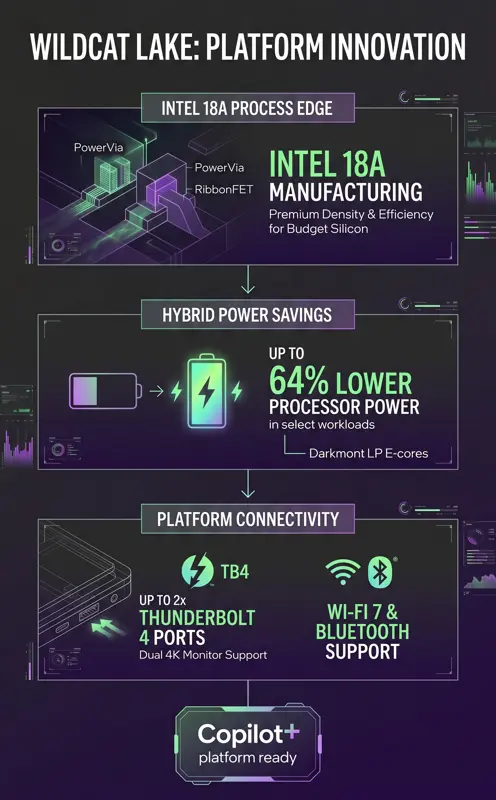
This is a monumental achievement for the company. The Intel 18A process node introduces RibbonFET transistors and PowerVia backside power delivery. These technologies allow for better power efficiency and higher clock speeds within a smaller physical footprint.
By bringing this premium manufacturing node down to the non-Ultra series, Intel is democratizing its best technology. The Wildcat Lake die actually uses the exact same IP foundations as the flagship Core Ultra Series 3 (Panther Lake).
The immediate benefit of the 18A process is power reduction. Intel claims up to 64% lower processor power in selected workloads when compared to the older Core 7 150U. This is exactly what is needed to challenge the MacBook Neo’s legendary battery life.
| Performance Metric | Improvement vs. Core 7 150U |
|---|---|
| Creation and Productivity | Up to 2.1x Faster |
| AI GPU Performance | Up to 2.7x Higher |
| Processor Power Consumption | Up to 64% Lower |
By utilizing the Intel 18A node for budget silicon, Intel is finally bringing premium transistor density and thermal efficiency to the masses.
A Hybrid AI-Ready Platform
In 2026, artificial intelligence is no longer restricted to premium workstations. Every user expects their operating system and applications to leverage machine learning for background blur, noise cancellation, and local generative tasks.
Intel proudly states that this is its first hybrid AI-ready Core Series platform in the budget sector. Inside the silicon, there is a dedicated NPU 5 (Neural Processing Unit) block.
This NPU alone is rated at 17 TOPS (Trillions of Operations Per Second). While this might not meet the strict 40 TOPS requirement of some advanced Copilot+ local features natively on the NPU, it is more than enough for everyday AI assistance.
However, when you combine the compute power of the CPU, the Xe3 GPU, and the NPU 5, the entire platform reaches up to 40 platform TOPS. This hybrid approach ensures that the laptop can handle a wide variety of machine learning workloads dynamically.
Advanced Connectivity and Future-Proofing
Budget laptops have historically suffered from poor connectivity standards, often shipping with outdated Wi-Fi cards and slow USB ports. Wildcat Lake changes this narrative completely.
The platform offers built-in support for up to two Thunderbolt 4 ports. This allows users to connect to high-speed external storage arrays, dual 4K monitors, or even external graphics docks with a single cable.
Furthermore, it supports Wi-Fi 7 and the latest Bluetooth standards. This ensures ultra-low latency for cloud gaming and reliable connections in congested networks like university lecture halls or busy coffee shops.
For more official updates on architecture and release timelines, you can always check the announcements directly on the Intel Newsroom.
When comparing the new chip to a five-year-old Core i7-1185G7 system, the upgrades are nothing short of transformative. Users holding onto older laptops will experience a night-and-day difference in responsiveness, graphical fidelity, and battery longevity.
| Platform Feature | Wildcat Lake Capability |
|---|---|
| Neural Processing Unit (NPU) | NPU 5 (17 TOPS) |
| Total Platform AI Power | Up to 40 TOPS |
| Wired Connectivity | Up to 2x Thunderbolt 4 Ports |
| Wireless Standards | Wi-Fi 7 & Advanced Bluetooth |
Final Thoughts on the Budget Laptop War
The arrival of the new Intel Core Series 3 mobile processors signifies a massive heat-up in the entry-level computing market. Apple has enjoyed largely uncontested dominance with its highly efficient base silicon, but Intel’s 18A technology is closing the gap fast.
By focusing heavily on dedicated LP E-cores and stripping away unnecessary power-hungry architecture, Intel has crafted a chip that prioritizes what budget users actually want: longevity and snappy everyday performance.
If manufacturers price these Wildcat Lake laptops aggressively, the new Core 7 could easily become the default recommendation for anyone needing a reliable, modern Windows machine without breaking the bank.
Frequently Asked Questions
What exactly is the Core 7 360?
It is a newly launched mobile processor from Intel’s non-Ultra Series 3 lineup, designed primarily for budget-friendly but highly efficient laptops to compete with Apple’s entry-level silicon.
How many cores does this new processor have?
It features a total of 6 cores. This is broken down into 2 high-performance Cougar Cove P-cores and 4 highly efficient Darkmont LP (Low Power) E-cores.
Are there any standard E-cores on this chip?
No. To maximize battery life and efficiency, Intel completely removed standard E-cores from this specific die, relying solely on the Low Power E-core variants for background tasks.
What type of graphics does the chip use?
It utilizes Intel’s new Xe3 integrated graphics architecture, featuring 2 Xe-cores capable of boosting up to 2.6 GHz, providing excellent performance for daily media and light gaming tasks.
What does “Wildcat Lake” mean?
Wildcat Lake is the internal Intel codename for the physical die and architecture used in the new Core non-Ultra Series 3 processors, built upon the advanced Intel 18A manufacturing process.
How capable is the AI on this budget processor?
The chip is highly capable. It includes a dedicated NPU 5 block rated at 17 TOPS, and when combined with the CPU and GPU, the platform can deliver up to 40 TOPS for hybrid AI workloads.
Does this processor support modern connectivity?
Yes. Despite being targeted at the budget and mainstream market, laptops featuring this chip can support up to two high-speed Thunderbolt 4 ports alongside cutting-edge Wi-Fi 7.
Disclaimer: This article is for informational purposes only. Hardware specifications, performance metrics, and technological capabilities are based on Intel’s 2026 press releases and pre-launch data, which are subject to real-world software variations and manufacturer configurations.