dell xps googlebook review units have finally hit the market in 2026, and the overall consensus paints a rather confusing picture for consumers. If every other computing platform succumbed to a super AI virus, leaving this machine as your only option, it might make sense. However, in the real world, this device is a massive contradiction.
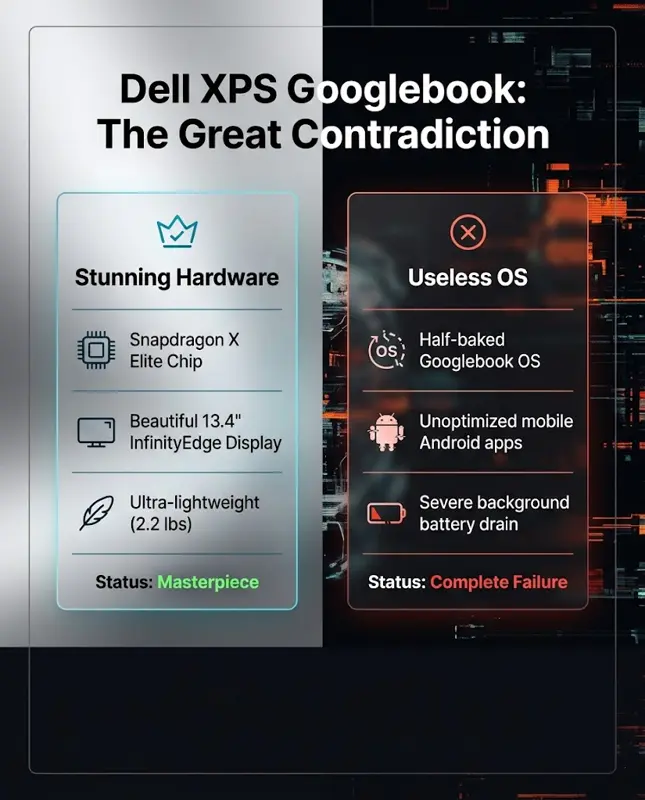
You are getting premium, lightweight hardware that feels incredible to use. Unfortunately, it is paired with Google’s half-baked, frustrating new Googlebook OS that struggles to run even the most basic desktop applications.
The Hardware Contradiction in our dell xps googlebook review
To fully understand this dell xps googlebook review, we must first praise the physical engineering. Dell took its recent XPS 13 design and refashioned it for Google’s new operating system. The result is a slim 2.2-pound metal case with a gorgeous 13.4-inch InfinityEdge screen.
It is powered by the Dell XPS Snapdragon X Elite chip paired with 16GB of RAM. This is the exact same premium hardware found on the $1,000 Windows 11 XPS 13. The keyboard is great, the touchpad is highly accurate, and the device is incredibly easy to carry in a backpack.
“The Dell XPS hardware remains an absolute masterpiece of modern engineering, making the software disaster that runs inside it even more tragic.”
However, the device only features two USB-C ports and completely omits the headphone jack. There is a multi-colored “Glowbar” on the rear to show battery status, but it feels like a superfluous gimmick rather than a productive tool.
| Hardware Specification | Details for the XPS Googlebook |
|---|---|
| Processor | Qualcomm Snapdragon X Elite |
| Memory (RAM) | 16GB (Excellent for multitasking) |
| Display | 13.4-inch InfinityEdge |
| Weight & Build | 2.2 pounds / Slim metal chassis |
dell xps googlebook review: The Complete Googlebook OS failure
The core issue highlighted in every honest dell xps googlebook review is the operating system. Googlebook OS is a messy combination of Android and ChromeOS. While it supports native Android apps on laptop screens, the implementation is severely lacking.
Using mobile applications on a desktop interface is awful. Slack only works as a mobile app, meaning you cannot view multiple channels at once. If you want to resize an image, you have to navigate a maze of unoptimized apps. Evernote does not even appear in the Googlebook Play Store, forcing users to rely on the web browser.
Furthermore, the heavily advertised phone sync feature is essentially useless. It simply leads to redundant notifications across your devices, offering no real advantage over existing Windows features.
Battery Drain Issues Highlighted in this dell xps googlebook review
One of the biggest selling points of the Snapdragon chip is supposed to be battery efficiency. In benchmarking apps, it lasted over 15 hours. But in real-world usage during our dell xps googlebook review, the software completely sabotaged the battery life.
Unoptimized Android apps eat up battery power for no reason. For example, leaving CapCut Pad open in the background drained the battery by 50% in just one hour. You simply cannot trust this machine to last through a full workday.
“Why would anyone pay $1,000 to be a beta tester for a half-baked platform that cannot even manage background battery drain efficiently?”
Google has also heavily pushed its Gemini AI laptop integration. While features like the Rambler AI dictation work decently well at cutting out “ums” and “uhhs,” they lack basic visual text feedback, making the AI integration feel like an afterthought rather than a revolution.
Windows 11 vs Googlebook: The Final dell xps googlebook review Verdict
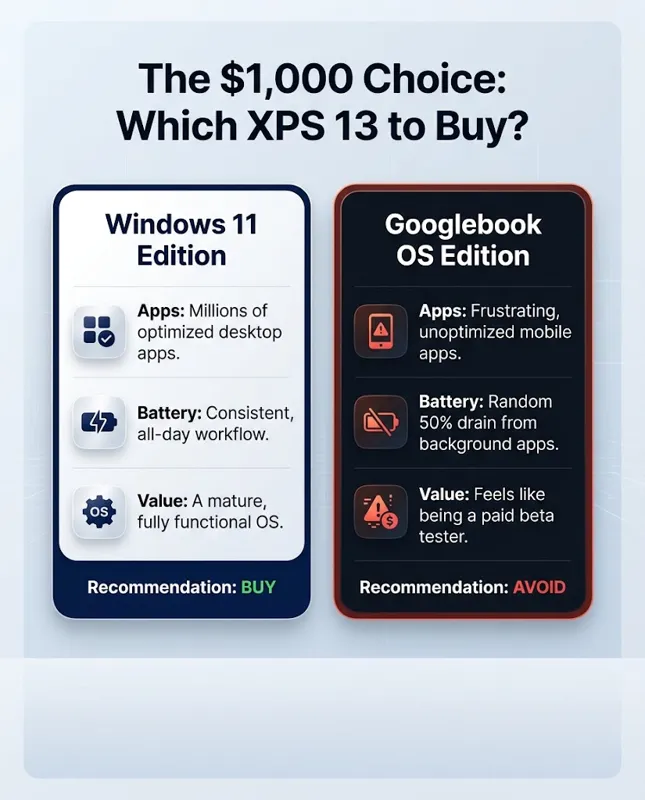
When comparing Windows 11 vs Googlebook, the choice is painfully obvious. You should absolutely buy the Windows 11 version of the exact same XPS 13 hardware. It costs the same $1,000, but it actually runs a mature operating system with massive developer support.
For more information on standard Windows configurations, you can visit the official Dell website to see their reliable PC options.
| Feature Comparison | Dell XPS (Windows 11) | Dell XPS (Googlebook OS) |
|---|---|---|
| Software Ecosystem | Mature, millions of desktop apps | Unoptimized mobile Android apps |
| Battery Reliability | Highly consistent all-day battery | Unpredictable background drain |
| Price Tag | $1,000 (Great value for the OS) | $1,000 (Overpriced for beta software) |
To conclude this dell xps googlebook review, the Googlebook launch may go down as one of the most baffling moments in recent computing history. Do not buy this machine hoping the software will eventually get better. Stick to established platforms.
Frequently Asked Questions
What is the main conclusion of the dell xps googlebook review?
The review concludes that while the Dell XPS hardware is beautiful and lightweight, the Googlebook OS is a half-baked, frustrating failure that ruins the entire experience.
How much does the Dell XPS Googlebook cost?
It retails for roughly $1,000, which is the exact same price as the much superior Windows 11 version of the XPS 13.
Can the Googlebook run standard desktop applications?
No, it relies on unoptimized Android apps from the Google Play Store and web applications, making complex tasks like photo editing or multi-channel Slack usage very difficult.
Is the battery life good on the XPS Googlebook?
While benchmarks show 15 hours, real-world usage is terrible. Unoptimized Android apps running in the background can drain the battery by up to 50% in just one hour.
Does the Googlebook feature Gemini AI laptop integration?
Yes, it includes Gemini AI features like Rambler AI dictation, but they feel unrefined and do not justify buying an entirely new laptop platform.
Is the phone sync feature useful?
Not really. It mostly leads to redundant notifications, and you can already sync your phone perfectly fine using a standard Windows or Linux computer.
Should I buy the Googlebook or the Windows 11 version?
You should absolutely buy the Windows 11 version. It offers a mature, fully functional operating system for the exact same price, saving you from a miserable software experience.
Disclaimer: This article is for informational purposes only. Opinions expressed are based on extensive tech testing and industry reviews of the product at the time of publication.