The phenomenon of vibe coding security risks apps has rapidly become the most alarming trend in software development for 2026. As artificial intelligence coding agents empower absolute beginners to build functioning software simply by typing prompts, a massive wave of vulnerable code is flooding the internet.
Your dream vibe-coded application might function perfectly on the surface, but underneath, it could be a complete security nightmare. The ease of creating these platforms has completely bypassed traditional quality assurance and code review processes.
We have officially entered the era of personal software, where anyone can use AI to create their own private tools. However, with this unprecedented accessibility comes a terrifying new era of unpatched vulnerabilities and massive data leaks.
Understanding the Core vibe coding security risks apps Present
To truly grasp the scope of vibe coding security risks apps, we must look at how these tools are actually being deployed. Apps may be incredibly easy to build right now, but they remain notoriously difficult to secure against sophisticated attacks.
This is especially true in a world where malicious actors can also use advanced AI systems to scan for and exploit these exact vulnerabilities. An amateur developer might generate an app in an hour, but a hacker can compromise it in seconds.
The core issue is a glaring oversight in the prompt-to-code pipeline. Most casual builders are entirely focused on the functionality and the user interface, treating the underlying architecture as a complete blindspot.
When you are learning this new technology, you assume the AI model knows best. Unfortunately, large language models prioritize outputting working code over outputting secure code unless explicitly instructed otherwise.
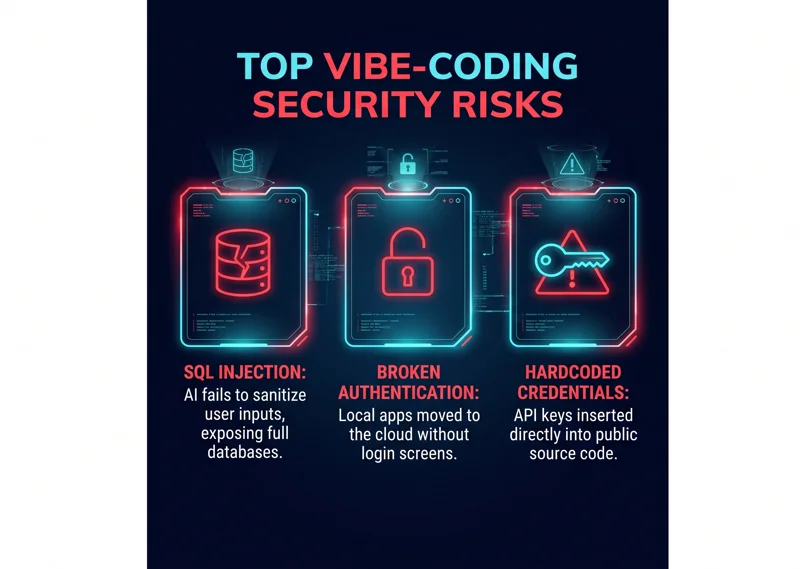
| Vulnerability Type | How It Happens in Vibe Coding | Potential Impact |
|---|---|---|
| SQL Injection | AI fails to sanitize user database inputs. | Total database exposure or alteration. |
| Broken Authentication | Developer moves local app to cloud without login screens. | Unauthorized access to sensitive user data. |
| Hardcoded Credentials | AI inserts API keys directly into the source code. | Hijacking of third-party connected services. |
Real-World Examples of vibe coding security risks apps
Consider the recent case of an application named “Boomberg.” The creator was delighted with his automated website that tracked tax money, launching it online immediately after generating it.
It wasn’t until months after the site went live that he realized a massive problem existed. There was a hidden SQL injection risk that could have left the site open for an attacker to read or alter the entire database.
This is the harsh reality of vibe coding security risks apps. Across social media, horror stories are piling up about automated platforms full of easily exploitable security vulnerabilities.
In another high-profile disaster, a founder posted about an AI coding agent wiping out his entire company’s production database due to a poorly generated migration script.
“My general core take is that vibe coding is not bad because amateurs can build software. The danger is when a personal app drifts into the realm of business software and stores shared data.”
Why vibe coding security risks apps Threaten Professional Industries
The impact of vibe coding security risks apps extends far beyond hobbyists building personal trackers. It is rapidly infiltrating the corporate world.
For instance, in the fast-paced realm of digital journalism and professional content creation targeting the United States market, managers frequently use AI to build custom SEO dashboards and workflow tools.
These custom internal tools often process sensitive editorial strategies, proprietary keyword research, and unreleased publication schedules.
If these industry-specific apps lack proper authentication, a simple misconfiguration could leak an entire media company’s strategy to the public internet.
The calculus changes immediately when vibe coding moves away from local apps for tracking meals and enters the realm of business data. Customer logs, financial records, and internal documents require enterprise-level protection.
The Authentication Blindspot in vibe coding security risks apps
One of the most terrifying vibe coding security risks apps harbor is the complete lack of basic authentication protocols.
When a builder tests an application on their local machine, it works perfectly. There is no need for a login screen because the environment is isolated to their personal computer.
However, when they transition that local app into the cloud using automated deployment scripts, they often carry over those exact same open-door policies.
They deploy their projects with a bunch of configuration options they simply do not understand. This leads directly to sensitive personal and professional data being heavily exposed.
| Environment | Security Assumption | Actual Risk Level |
|---|---|---|
| Localhost (Your PC) | Safe by isolation. | Very Low |
| Cloud Deployment (Public) | Assumes AI handled security. | Extremely High |
How False Confidence Amplifies vibe coding security risks apps
The psychological aspect of vibe coding security risks apps cannot be ignored. When an AI tool tells you the code is secure and ready to deploy, it is incredibly easy to believe it.
In a normal coding session with an LLM, the build just keeps going. The system does not stop to check its own work unless you explicitly instruct it to run a vulnerability scan.
Most casual coders do not know they need to ask for a security review. They simply see a working interface and assume the backend is equally polished and robust.
This overconfidence exponentially increases the number of risks being pushed into production environments worldwide.
Mitigating vibe coding security risks apps Before Launch
To combat vibe coding security risks apps, developers must drastically change their prompt engineering workflows.
You have to prompt for security up front when you begin building. You must clearly define your threat model and tell the AI what kind of sensitive information the software will handle.
Then, you must prompt for security again at the very end of the process. Any time the tool has access to data you care about, a comprehensive review is mandatory.
“A lot of security is contextual. While it doesn’t hurt to run a coding agent’s own review, beware of a false sense of security if the agent doesn’t understand your specific threat model.”
Security tools do exist within these platforms. For example, Claude Code features specific commands that scan for vulnerabilities, but you must manually invoke them.
There are automatic versions available, but they usually require setting up pull requests in advance. This is a complex step that the vast majority of casual builders skip entirely.
Advanced Strategies to Stop vibe coding security risks apps
If you are serious about preventing vibe coding security risks apps, you need to rely on external verification frameworks.
Organizations should heavily reference standardized protocols to ensure their AI-generated code meets basic safety thresholds before it ever touches a public server.
For more detailed frameworks, you can review the OWASP AI Security Guidelines which outline how to handle these modern threats.
Furthermore, third-party skills and add-on instruction packs are becoming available. These tools point a coding agent at specific security tasks, like flagging insecure default settings.
| Mitigation Tactic | Implementation Difficulty | Effectiveness |
|---|---|---|
| Prompting for Security | Low (Just ask the AI) | Moderate |
| Using External Security Skills | Medium | High |
| Human Code Review | High (Requires expertise) | Very High |
The Double-Edged Sword of vibe coding security risks apps
While add-on security skills help mitigate vibe coding security risks apps, they also present a new vector for cyberattacks.
Malicious instruction packs exist in the wild. If you download the wrong skill from an open registry, you might inadvertently install a dependency that steals your credentials.
It is still the Wild West in the world of AI software generation. You must carefully audit every single tool, agent, and add-on you integrate into your workflow.
The Corporate Threat of vibe coding security risks apps
The potential damage of vibe coding security risks apps is absolutely not limited to hobbyists tinkering in their bedrooms.
Sales, marketing, and engineering teams at massive Fortune 500 companies are now shipping far more agent-written code than ever before in history.
Security teams desperately need baseline visibility into how these AI agents are being used across their enterprise networks.
Without strict corporate guardrails, an enthusiastic marketing manager might vibe-code a customer outreach tool that accidentally leaks thousands of private email addresses.
“The difference between a fun project and a horror story starts with knowing what questions to ask before you move it from your own device into the cloud.”
To safely navigate vibe coding security risks apps, enterprise leaders must enforce policies that stop flaws before the code is even written.
This means utilizing platforms that mandate security checkpoints and require human sign-off for any application handling sensitive client data.
Future-Proofing Against vibe coding security risks apps
As we look forward, the sheer volume of vibe coding security risks apps will only multiply as models become faster and more capable.
The open question for the industry is what the world will look like when the vast majority of digital infrastructure ships without any human ever reading the source code.
For now, the answer for the rest of us is to stay vigilant. You must think deeply about what information your creation holds and what the worst-case scenario looks like.
Keep your data local whenever possible. Be extremely cautious about what you host on public servers and always assume your AI has made a critical mistake.
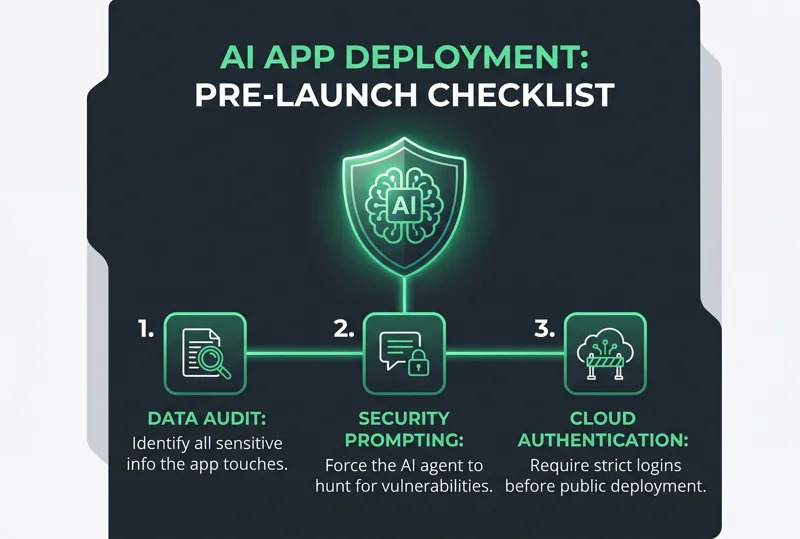
| Pre-Launch Checklist | Action Required |
|---|---|
| Data Audit | Identify all PII and sensitive info the app touches. |
| Authentication Check | Ensure cloud databases require strict login credentials. |
| AI Vulnerability Scan | Prompt the LLM to specifically hunt for SQL injections. |
Final Thoughts on vibe coding security risks apps
Ultimately, vibe coding security risks apps represent the growing pains of a revolutionary technological leap.
Building your own software is empowering, but it carries profound responsibility. Treat every AI-generated script as untrusted until thoroughly verified.
If you are handling medical data, financial records, or corporate strategy documents, it is entirely worth the investment to hire a human security engineer.
Do not let the convenience of instant code blind you to the devastating reality of data breaches. Build smart, test rigorously, and secure everything.
Frequently Asked Questions
What exactly are vibe coding security risks apps?
They are hidden vulnerabilities, like SQL injections and exposed databases, found in applications built entirely by AI coding agents under the direction of casual, non-technical users.
Why do AI agents generate insecure code?
Large language models prioritize generating functional, working code based on user prompts. Unless specifically instructed to prioritize security, they often take shortcuts that leave data exposed.
Is it safe to vibe-code a personal app?
Yes, it is generally safe if the application runs strictly on your local machine and does not handle highly sensitive personal or financial information.
What happens when I move my vibe-coded app to the cloud?
Moving a local app to the cloud often exposes it to the public internet. If you have not implemented proper authentication and database security, hackers can easily steal your data.
How can I force my AI agent to write secure code?
You must explicitly prompt the AI to prioritize security. Ask it to define a threat model, sanitize all database inputs, and run a self-review for vulnerabilities before finalizing the code.
Are big companies also affected by vibe coding security risks apps?
Absolutely. Employees in sales, marketing, and engineering are increasingly using AI to build internal tools, which can inadvertently leak proprietary corporate data if not properly monitored.
Should I hire a human to check my AI-generated code?
If your application handles customer logs, medical data, financial records, or any sensitive information, it is highly recommended to have a professional security engineer review the final codebase.
Disclaimer: This article is for informational purposes only. The cybersecurity landscape changes rapidly, and readers should consult with certified IT security professionals before deploying software handling sensitive data.