The stability of the North Atlantic Subpolar Gyre is currently the most urgent focus of global climate scientists in 2026. A dedicated team of international researchers is heading to Greenland aboard the UK polar research ship, RRS Sir David Attenborough, to study a rapidly unfolding environmental crisis.
Their mission is critical. They are investigating how quickly melting ice sheets are pushing vital ocean currents toward a complete collapse. If this complex system breaks down, the weather patterns we rely on could drastically change.
Understanding the Threat to the North Atlantic Subpolar Gyre
For decades, the North Atlantic Subpolar Gyre has functioned as a massive global thermostat. It regulates deep and surface currents that help keep temperatures mild in regions that would otherwise experience freezing conditions.
However, tidewater glaciers melting at an unprecedented rate are pouring massive amounts of freshwater into the ocean. This sudden influx threatens the delicate salt and temperature balance required to keep the North Atlantic Subpolar Gyre circulating properly.
To fully understand this crisis, researchers launched the GIANT climate analysis project. Led by Dr. Kelly Hogan, a marine geophysicist, this six-week expedition aims to gather pioneering data on glacier-ocean interactions directly at the source.
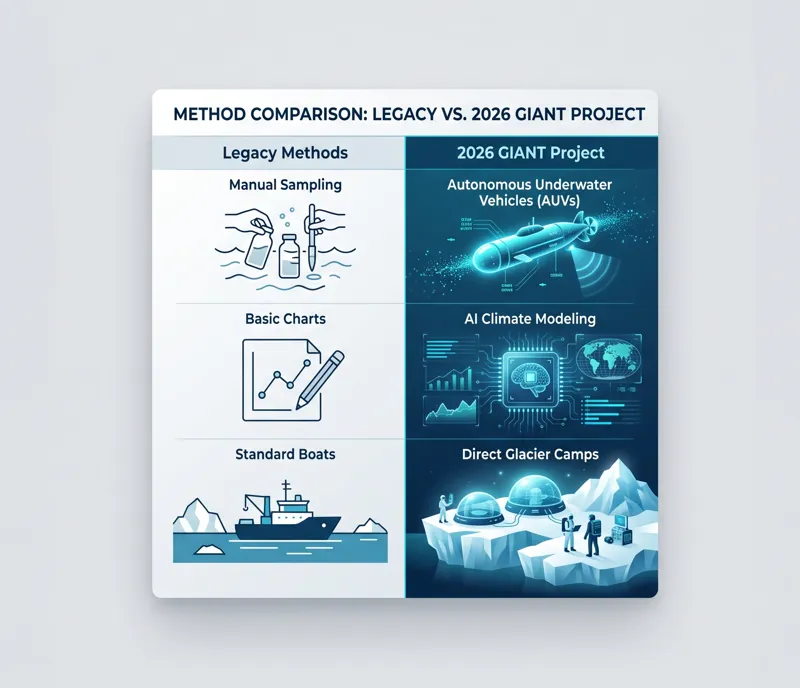
| Research Focus | Legacy Methods | 2026 GIANT Project Methods |
|---|---|---|
| Data Collection | Manual surface sampling | Autonomous underwater vehicles |
| Predictive Analysis | Standard historical projections | Advanced AI climate modeling |
| Target Area | General ocean temperatures | Direct tidewater glacier camps |
“We’re in a moment where our tools have finally caught up with our questions. With autonomous vehicles, advanced sensors and powerful modelling – boosted by AI – we can explore glacier-ocean interactions in ways that were unimaginable just a few years ago.”
How the North Atlantic Subpolar Gyre Affects Global Weather
If the North Atlantic Subpolar Gyre continues to weaken, the consequences will be felt globally. Current climate models have historically struggled to accurately represent how Greenland’s ice interacts with warming oceans.
According to experts from the British Antarctic Survey, a breakdown of this system could severely slow down the transfer of vital heat. In the short term, this means drastic changes in rainfall and storm intensity within the next decade.
This poses a massive threat to our daily lives. Unpredictable weather affects farmers relying on stable seasons, threatens water reservoirs, and destabilizes commercial fish stocks that depend on the North Atlantic Subpolar Gyre for nutrient distribution.
Could the Collapse of the North Atlantic Subpolar Gyre Cause an Ice Age?
The most alarming scenario surrounding the North Atlantic Subpolar Gyre is a complete shutdown. Scientists warn that a total breakdown could plunge large parts of the Northern Hemisphere into a new localized ice age.
While an ice age sounds like a Hollywood movie plot, the science behind it is very real. Without the North Atlantic Subpolar Gyre pushing warm water northward, freezing Arctic temperatures would push much further south, devastating modern infrastructure.
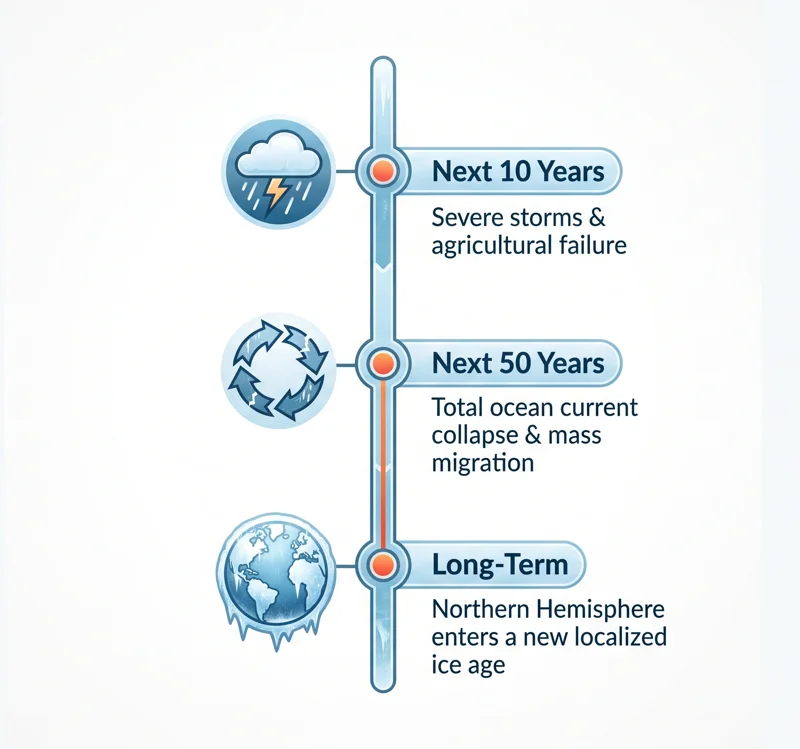
| Timeframe | Predicted Environmental Impact | Human Consequence |
|---|---|---|
| Next 10 Years | Shift in rainfall patterns and intense winter storms | Agricultural failure and reservoir depletion |
| Next 50 Years | Total North Atlantic Subpolar Gyre collapse | Mass migration and severe economic depression |
| Long-Term | Northern Hemisphere enters a new ice age | Permanent loss of habitable northern regions |
“What happens in Greenland really affects what happens in the UK and North America. Melt more ice, and you get more freshwater slowing down the transfer of heat.”
The Future of the North Atlantic Subpolar Gyre Research
By establishing camps near the glaciers themselves, researchers can now feed real-time, highly accurate data into AI climate modeling systems. This gives humanity a much clearer timeline regarding the North Atlantic Subpolar Gyre and its potential collapse.
While the immediate future looks challenging, understanding the exact mechanics of the North Atlantic Subpolar Gyre is the first step toward mitigation. This expedition represents our best chance to prepare for the inevitable climate shifts ahead.
Ultimately, saving the North Atlantic Subpolar Gyre requires global cooperation. The data collected by the GIANT project in 2026 will undoubtedly shape international environmental policies for decades to come.
Frequently Asked Questions
What is the North Atlantic Subpolar Gyre?
It is a major system of ocean currents located in the Atlantic Ocean that helps distribute heat globally and stabilizes the climate in the Northern Hemisphere.
Why are scientists studying the North Atlantic Subpolar Gyre in 2026?
Scientists are urgently studying it because rapidly melting ice in Greenland is pouring freshwater into the ocean, which threatens to slow down or collapse this vital current system.
What is the GIANT climate analysis project?
It is a six-week research expedition led by experts to study glacier-ocean interactions using advanced sensors, autonomous vehicles, and AI climate modeling.
How does melting ice affect ocean currents?
Massive amounts of freshwater from melting tidewater glaciers lower the salinity and density of the ocean water, which interrupts the natural sinking and circulating process of the currents.
Could a collapse really cause a new ice age?
Yes. If the currents collapse, the mechanism that pushes warm water northward will stop, potentially plunging large parts of the Northern Hemisphere into a new ice age.
How will this affect normal daily life in the short term?
Within the next decade, a slowing current could drastically alter rainfall patterns, cause extreme winter storms, disrupt farming, and threaten commercial fish stocks.
How is AI helping this expedition?
Researchers are using AI climate modeling combined with real-time data from autonomous vehicles to create much more accurate predictions of how glaciers and oceans interact.
Disclaimer: This article is for informational purposes only. The findings and climate models discussed are based on ongoing scientific research and predictive analysis regarding the North Atlantic Subpolar Gyre and global weather systems.