'/%3E%3Cpath%20d='m454%20250-4%204-4-4c-3%203-9%205-9%205l2-5q-9%205-10%203c-1-1%2010-12%2012-26%200-1%203-18-8-13-2%201-4-5%200-7%203-2%2010-1%2011%200q1-2%203-2c2%200%2011%201%2014%206%202%205%202%2014%202%2015q0%2015%208%2027c-1%201-8-2-8-2v3s-7-2-9-4m-12-32c4%2014-9%2031-11%2033%2011%200%2012-10%2015-24l1%201c-2%2011-5%2022-8%2025l7-4%203-22h1l-3%2022%203%203%203-3-1-21h1l1%2021%208%203c-5-8-6-25-6-23h1c2%2012%203%2022%2012%2022-3-3-8-16-7-25q0-12-2-15-6-3-10%202-2%202-5-1c-2-2-1-2-6-4q-7-2-6%205s9-3%2013%205zm7-8q-3%201-1%202%203%200%201-2'/%3E%3C/g%3E%3C/svg%3E)
Attackers conceal phishing lures using invisible Unicode characters, marking a significant evolution in cybersecurity threats as we navigate through 2026.
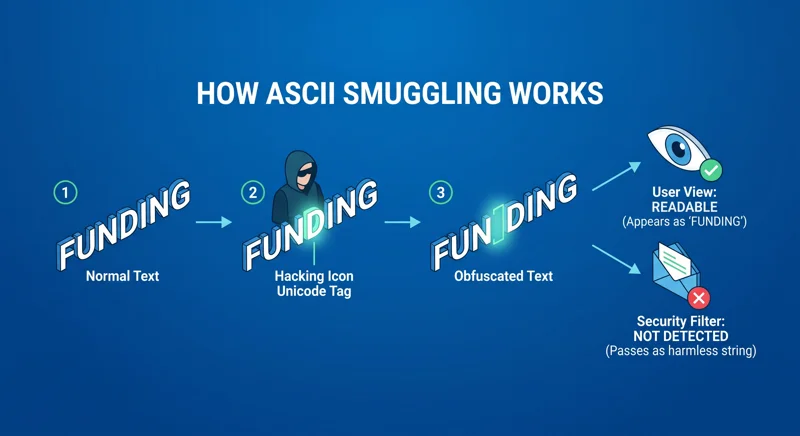
This highly deceptive method, commonly known as the ASCII smuggling technique, allows cybercriminals to bypass sophisticated email security filters with alarming ease.
By inserting completely invisible tags into standard text, threat actors effectively blind automated defense systems while leaving the message perfectly readable for the human victim.
How Attackers Conceal Phishing Lures Using Invisible Unicode Characters
You might be wondering precisely how attackers conceal phishing lures using invisible Unicode characters during massive phishing campaigns.
The mechanics involve injecting specific unrenderable symbols from the Unicode Tags block (U+E0000–U+E007F) directly into heavily monitored financial keywords.
For example, when an attacker targets a victim with a loan scam, a flagged keyword like “funding” is secretly split into multiple pieces.
The email security filters process this as a broken string of harmless letters, successfully evading detection rules based on static keyword lists.
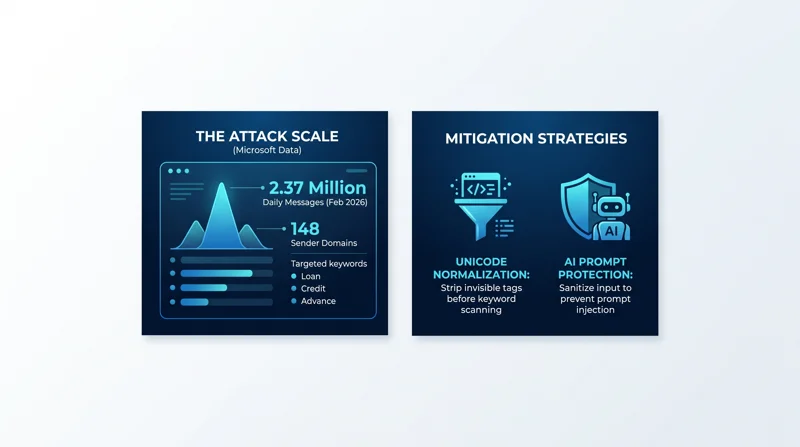
“The high-volume phase persisted for roughly three months, peaking at over 2.37 million daily messages before dropping sharply.”
This widespread operation heavily utilized legitimate infrastructure, proving that traditional reputation checks alone are no longer sufficient.
The Scale When Attackers Conceal Phishing Lures Using Invisible Unicode Characters
Microsoft threat researchers recently uncovered a massive cluster of finance-themed domains powering this exact operation.
Telemetry data confirms that when attackers conceal phishing lures using invisible Unicode characters, they can execute campaigns at an unprecedented scale.
By utilizing compromised domains and legitimate marketing platforms, the perpetrators managed to blast millions of malicious messages globally.
| Attack Method | Detection Rate | Primary Mechanism |
|---|---|---|
| Standard Phishing | High (Over 99%) | Keyword Matching |
| ASCII Smuggling | Initially Low | Invisible Unicode Tags |
Why Attackers Conceal Phishing Lures Using Invisible Unicode Characters in AI
The danger extends far beyond traditional inbox delivery, deeply affecting modern artificial intelligence systems.
In recent months, cybersecurity experts have observed that attackers conceal phishing lures using invisible Unicode characters to facilitate dangerous AI prompt injection attacks.
Because large language models process the invisible text as valid instructions, an attacker can secretly encode a malicious payload that the AI blindly executes.
If you want to understand the full scope of these vulnerabilities, you can read more from Microsoft Security Experts regarding AI risk mitigation.
Expert Mitigation Against Invisible Unicode Characters
Protecting enterprise networks requires a fundamental shift in how incoming text strings are analyzed and processed.
Because attackers conceal phishing lures using invisible Unicode characters, IT administrators must aggressively normalize all text inputs.
Before any message is passed to an AI assistant or scanned by traditional keyword filters, unexpected tag-block characters must be stripped completely.
“Security defenders must treat unexpected tag-block characters as a strong anomaly to prevent sophisticated ASCII smuggling attacks.”
| Security Layer | Recommended Action | Expected Outcome |
|---|---|---|
| Email Gateways | Normalize all Unicode text | Reveal hidden financial keywords |
| AI Assistants | Strip invisible tag blocks | Prevent prompt injection attacks |
Adapting Security Posture in 2026
As the cybersecurity landscape evolves, legacy signature-based detection is quickly becoming obsolete against obfuscation techniques.
Knowing that attackers conceal phishing lures using invisible Unicode characters allows defense teams to build smarter heuristic rules.
By identifying the heavy use of these obscure characters as a definitive red flag, organizations can proactively block malicious traffic before it reaches the end user.
Frequently Asked Questions
How do attackers conceal phishing lures using invisible Unicode characters?
They inject unprintable symbols from the Unicode Tags block directly into trigger words, breaking the word apart so basic security filters cannot recognize it.
What exactly is the ASCII smuggling technique?
It is an advanced evasion method where cybercriminals encode hidden malicious payloads or obfuscate keywords using completely invisible characters.
Why do attackers conceal phishing lures using invisible Unicode characters instead of regular encryption?
Invisible tags render normally to the human eye, maintaining the social engineering illusion, but appear as fragmented, unrecognizable text to legacy scanning software.
Can AI prompt injection attacks leverage this exact method?
Yes, AI assistants and large language models process the hidden text as valid instructions, which can lead to a highly successful prompt injection.
How can modern businesses effectively stop this threat?
Companies must normalize all text inputs, proactively strip unexpected Unicode tags, and utilize advanced heuristic scanning across their gateways.
Did Microsoft threat researchers successfully identify this campaign?
Yes, they discovered a massive campaign peaking at 2.37 million daily messages and successfully flagged 148 domains utilizing this exact evasion method.
When attackers conceal phishing lures using invisible Unicode characters, do standard filters work?
Standard filters relying purely on static word lists will fail; however, filters evaluating sender reputation, IP address, and domain history can still catch these threats.
Disclaimer: This article is for informational purposes only. The cybersecurity landscape changes rapidly, and readers should consult with certified IT security professionals before implementing defensive strategies.