AI and the rise of the universal entertainment app represents the single most important transformation in modern digital media today.
For over a decade, digital entertainment was strictly compartmentalized. Users opened dedicated platforms for specific media types: one for music, another for movies, a third for podcasts, and separate applications for short videos or mobile gaming.
However, market maturity and slowing subscriber growth have forced a dramatic strategic pivot across the entire technology sector.
Today, major media corporations are abandoning single-format business models to capture every fraction of consumer downtime within a unified digital ecosystem.
Understanding AI and the Rise of the Universal Entertainment App
The driving force behind this shift comes down to total engagement time and revenue per user.
Rather than fighting exclusively for new subscriber sign-ups, platforms are working tirelessly to expand their feature sets so users never need to leave the screen.
This industry-wide shift highlights the momentum behind AI and the rise of the universal entertainment app as a dominant business strategy.
Modern creators now work across multiple formats simultaneously, producing video clips, audio podcasts, live streams, and written updates under one personal brand.
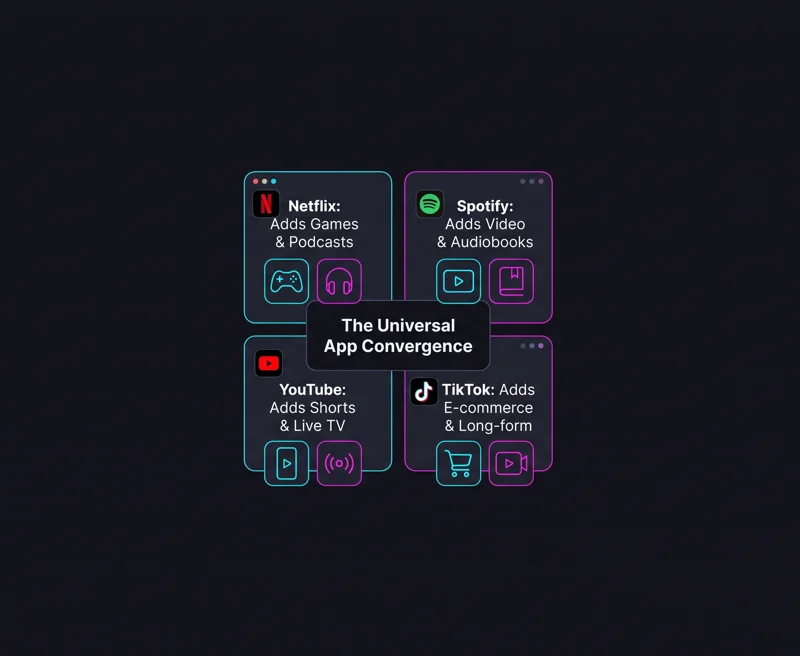
| Platform | Original Core Format | Expanded Formats Introduced |
|---|---|---|
| Netflix | Long-form Video Streaming | Mobile Gaming, Live Events, Short Clips, Podcasts |
| Spotify | Music Streaming | Video Podcasts, Audiobooks, Messaging, Social Q&As |
| YouTube | User-Generated Long Video | Short-form Shorts, Music, Live TV, Movies, Gaming |
| TikTok | Short-form Mobile Video | Long-form Video, E-commerce, Ticket Sales, Microdramas |
Key Drivers Behind AI and the Rise of the Universal Entertainment App
While economic pressures motivated companies to broaden their scope, artificial intelligence provided the practical machinery required to execute it efficiently.
In past years, managing completely separate media formats required vast, dedicated engineering teams and distinct operational structures.
Now, generative models and unified coding platforms allow a single software platform to scale across music, video, audiobooks, and interactive games simultaneously.
“The battle for digital entertainment is no longer about winning a single format, but becoming the default operating system for all consumer downtime.”
How Tech Giants Power AI and the Rise of the Universal Entertainment App
Artificial intelligence serves as the ultimate connective tissue for these converging applications.
Advanced AI content recommendation algorithms analyze user behavioral signals across wildly different media formats.
Whether you want a 15-second short clip, a 45-minute audio episode, or a two-hour feature film, predictive neural networks determine your exact preference at any given moment.
This intelligent, multi-format personalization defines the core experience of AI and the rise of the universal entertainment app.
For instance, YouTube relies heavily on unified generative tools to automate multi-language dubbing and power intelligent content search features.
According to updates shared on the official YouTube Blog, millions of creators actively use integrated AI tools to generate content and optimize user discovery.
Similarly, Netflix has invested millions in generative AI assets and advanced recommendation architectures to refine personalized user feeds across games, live sports, and films.
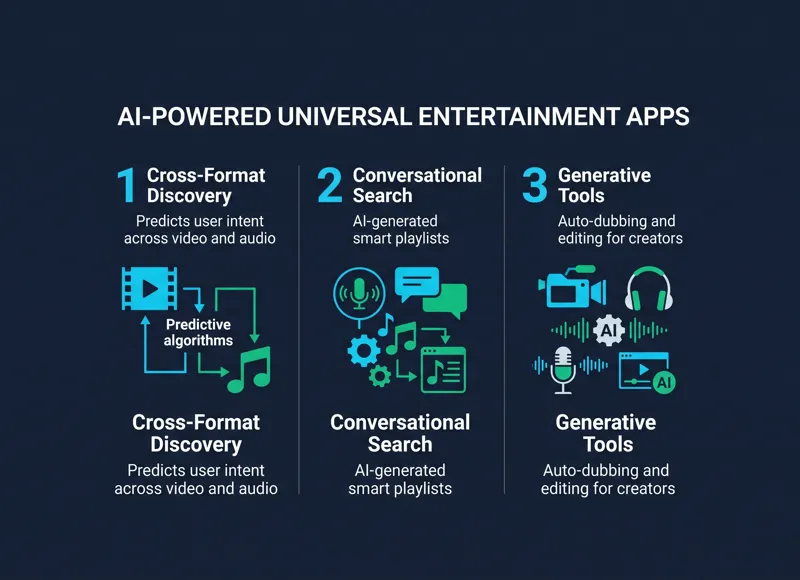
| AI Integration Area | Function in Universal Apps | Consumer Benefit |
|---|---|---|
| Cross-Format Discovery | Predicts interest across text, audio, and video | Seamless recommendations without switching apps |
| Conversational AI Chat | Allows natural language queries for playlists and media | Instant, hyper-personalized playlist creation |
| Generative Creation Tools | Automates dubbing, editing, and thumbnail generation | Higher content diversity and rapid localization |
“Generative AI bridges content boundaries, enabling a single mobile platform to deliver personalized video, music, and gaming experiences dynamically.”
The Consumer Impact of AI and the Rise of the Universal Entertainment App
For everyday users, the consolidation offers clear convenience. Managing fewer active subscriptions simplifies digital billing and reduces app switching.
However, platform lock-in increases dramatically as these universal environments capture more behavioral data.
As applications become identical in feature scope, user retention depends entirely on recommendation accuracy and algorithm strength.
This competitive dynamic continues to accelerate AI and the rise of the universal entertainment app across global consumer tech markets.
Future Outlook for AI and the Rise of the Universal Entertainment App
As media boundaries dissolve completely, the coming market battle will not be fought between video services or audio services separately.
Instead, tech giants will compete to be the primary home screen destination whenever a user unlocks their device to kill time.
Expect deeper integrations of interactive gaming, live streaming, social shopping, and generative audio across all major consumer software ecosystems.
The era of single-purpose streaming applications is officially coming to a close, replaced by intelligent, multi-format digital hubs.
Frequently Asked Questions (FAQs)
What does AI and the rise of the universal entertainment app mean for consumers?
It means entertainment platforms like Netflix, Spotify, and YouTube are offering video, music, gaming, and podcasts within a single app to keep users engaged longer.
Why are streaming services adding formats outside their original category?
User acquisition growth has slowed, prompting companies to focus on keeping existing subscribers engaged inside their ecosystem to maximize ad revenue and subscription retention.
How does artificial intelligence facilitate universal entertainment apps?
AI powers smart cross-format recommendation algorithms, speeds up app development, automates dubbing and moderation, and provides natural language search tools.
Will single-format apps like dedicated music or video players disappear?
While standalone apps will still exist, dominant platforms are moving toward multi-format models to remain competitive in total watch and listen time.
How does AI help creators on universal entertainment platforms?
AI provides integrated creation tools, automatic translation, interactive search optimization, and automated editing, making cross-format distribution easier.
Does this trend lead to higher subscription prices?
Tiered access models and bundled offerings are becoming common, allowing platforms to charge higher subscription rates as they offer broader content catalogs.
How do cross-format media platforms affect personal data privacy?
As apps collect interaction data across music, video, gaming, and shopping habits, their user profiles become vastly more detailed for targeted advertising.
Disclaimer: This article is for informational purposes only. Features, business models, and software functionalities are subject to change by respective platform operators.