


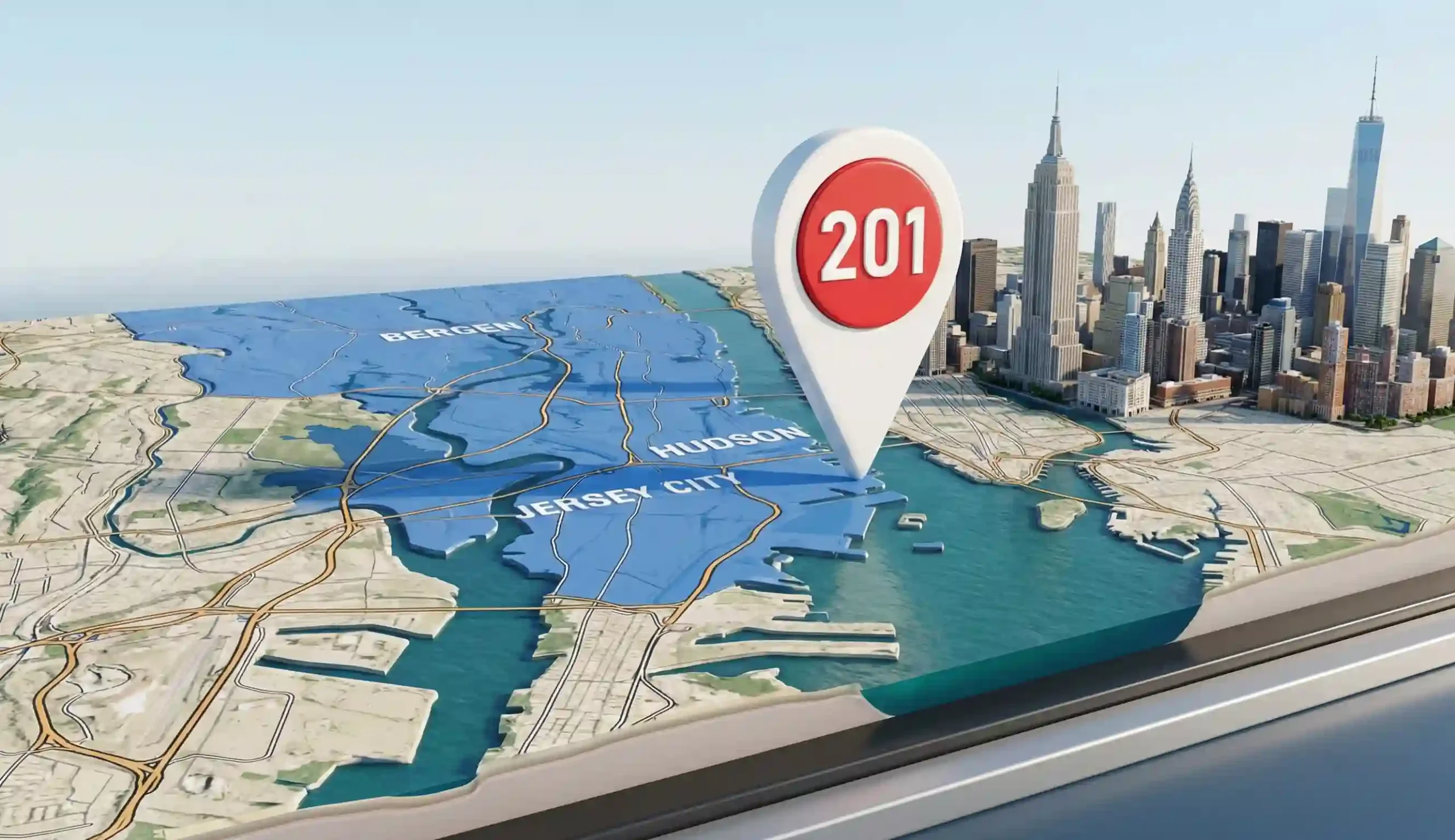
The 201 area code is the original North American area code for New Jersey, first activated on January 1, 1947, and still serving North Jersey today. It now works in an overlay with 551 and covers key Hudson River communities just across from New York City, including Jersey City, Hoboken, and Hackensack.
Getting a call from the 201 area code? Don’t guess. Use our free tool below to instantly verify the location, time zone, and spam risk before you pick up.
US Area Code & Spam Verifier
Enter a 3-digit area code or full US phone number:
What Is the 201 Area Code?
The 201 area code is a general purpose geographic code assigned to New Jersey in the United States under the North American Numbering Plan (NANP). It is officially located in New Jersey (NJ), with the country field marked as US and the time zone marked as E for Eastern Time.
Key technical facts:
-
Type of code: General Purpose Code (used for regular landline and mobile service).
-
Status: Assigned, assignable, and currently in use (flagged “Y” for in use).
-
Geographic vs. non‑geographic: Marked as G, meaning it is tied to a physical region.
-
In‑service date: January 1, 1947, making it the first NPA code in the U.S. numbering system.
-
Overlay complex: 201/551, meaning both area codes serve the same territory.
Because of its age and prominence, 201 has become a signature code for North Jersey and part of the region’s identity.
Geography and Coverage: Where Is 201 Located?
Today, area code 201 covers the northeastern corner of New Jersey, primarily most of Hudson County and Bergen County.
Major counties
-
Hudson County – Urban waterfront communities facing Manhattan, including Jersey City, Hoboken, Bayonne, and Union City.
-
Bergen County – Suburban and commercial hubs like Hackensack, Fort Lee, Englewood, and surrounding towns.
Major cities and communities in 201
Commonly associated cities and towns within the 201 NPA include:
-
Jersey City – A major financial, residential, and transit hub on the Hudson waterfront.
-
Hoboken – Dense urban city known for its waterfront skyline views and commuter access to Manhattan.
-
Hackensack – County seat of Bergen County and a key healthcare/retail center.
-
Bayonne – Port and residential city with significant industrial and logistics activity.
-
Union City, West New York, Fort Lee, Englewood, Secaucus – High‑density urban/suburban communities integrated into the New York metro economy.
Proximity to New York City
The 201 area code sits directly across the Hudson River from Manhattan, forming part of the greater New York City metropolitan area. Residents often commute daily into NYC via PATH trains, ferries, buses, and bridges/tunnels, making 201 numbers feel “New York–adjacent” without being New York numbers.
History and Evolution of the 201 Area Code
1947: The first U.S. area code
When AT&T introduced the North American Numbering Plan in 1947, 201 was the first assigned area code in the country, and it originally covered all of New Jersey. The NANPA technical record lists its in‑service date as 01/01/1947, confirming its status as an original code. Early on, 201 also hosted the first direct‑dialed long‑distance call in 1951, from Englewood, NJ to Alameda, CA.
Splits that shrank 201’s footprint
As New Jersey’s population and phone demand grew, 201 was split multiple times, shrinking from a statewide code to a North Jersey‑only code:
-
1956: Introduction of area code 609, removing southern New Jersey from 201.
-
1991: Area code 908 created, carving out central New Jersey.
-
1997: Area code 973 created, further reducing 201’s coverage to the northeastern corner of the state (Hudson and most of Bergen counties).
After these changes, 201 became mainly associated with North Jersey urban and suburban communities near New York City, rather than the entire state.
Transition to overlay: Avoiding another split
By the late 1990s, 201 was once again nearing number exhaustion because of:
-
The rise of mobile phones and pagers
-
Growth in business lines and fax numbers
-
Expansion of VoIP and internet‑based services
Instead of splitting the region again, regulators opted for an overlay solution—leading to the introduction of area code 551 in 2001.
The 201 & 551 Overlay: How It Works
What is the 201/551 overlay complex?
NANPA defines an overlay complex as a combination of two or more area codes serving the same geographic territory. The 201 report explicitly lists Overlay Complex: 201/551, confirming that both codes share the same North Jersey footprint.
Area code 551 was added on December 29, 2001 as an overlay to 201 to provide more numbering capacity without changing existing 201 numbers. Both codes sit in the Eastern Time Zone and cover the same counties and major cities.
What it means for residents and businesses
With the overlay:
-
Existing 201 numbers kept their area code; no one was forced to change their number.
-
New numbers in the region may be issued as either 201 or 551, depending on availability.
-
Ten‑digit dialing (area code + 7‑digit number) became standard for local calls in the overlay region.
This arrangement ensures continuous growth for residential, business, and wireless services, while preserving the historic 201 identity for long‑time subscribers.
Technical Dialing Guide for the 201 Area Code
The NANPA dialing plan for 201 clearly defines how calls should be made within and outside the area. The table distinguishes between Standard and Permissive dialing patterns:
Standard vs. permissive dialing
In the NANPA report:
-
Standard = Preferred or default dialing pattern for the region.
-
Permissive = An alternative format that may be allowed by some service providers or under certain conditions.
Dialing rules from the NANPA record
From the 201 dialing plan:
-
Home NPA Local Calls (local calls within 201/551 region)
-
Standard: 10D (10‑digit dialing: area code + 7‑digit number).
-
Permissive: 1+10D (you may prefix a “1” if your carrier allows it).
-
-
Foreign NPA Local Calls (local, but to another area code)
-
Standard: 1+10D.
-
Permissive: NA (no alternative listed).
-
-
Home NPA Toll Calls (long‑distance within the 201/551 region)
-
Standard: 10D.
-
Permissive: 1+10D.
-
-
Foreign NPA Toll Calls (long‑distance outside 201/551)
-
Standard: 1+10D.
-
No permissive pattern listed.
-
The plan also includes a specific note: “Calls between the 551 and 201 NPAs may be dialed as 10D. 1+10 digit permissible at service provider discretion.” This means residents can generally dial between 201 and 551 numbers using just 10 digits, while some carriers let you add “1” first if desired.
Practical dialing examples for residents
-
Calling a friend in Jersey City from Hoboken (both 201):
-
Dial 201 + XXX‑XXXX (10 digits).
-
-
Calling a 551 number in Hackensack from a 201 number in Bayonne:
-
Dial 551 + XXX‑XXXX (10 digits; overlay local call).
-
-
Calling a number outside the region (e.g., a 212 NYC number):
-
Dial 1 + 212 + XXX‑XXXX (foreign NPA toll).
-
Carriers can still have minor local variations, but the NANPA plan is the reference standard for the 201/551 complex.
Spam, Scams, and “Neighbor Spoofing” in the 201 Area Code
Because 201 numbers are strongly associated with North Jersey and the NYC metro, scammers often exploit them using a tactic known as neighbor spoofing.
What is neighbor spoofing?
Neighbor spoofing occurs when robocallers or fraudsters fake (spoof) their caller ID to show a local‑looking number—often sharing your area code and even the same first three digits of your phone number. The goal is to trick you into answering by making the call appear to be from a neighbor, nearby business, or local service.
For 201:
-
Scammers may use 201‑XXX‑XXXX or 551‑XXX‑XXXX formats to appear as a local New Jersey contact.
-
They target residents and businesses who tend to answer “familiar‑looking” local numbers more readily.
Common scam themes using 201 numbers
Scam calls using 201/551 spoofed numbers often claim to be:
-
Debt collection agencies or “legal departments” threatening action.
-
Utility companies or telecom providers demanding immediate payment.
-
Government agencies (IRS, Social Security) warning about “urgent issues.”
-
Tech support, parcel delivery issues, or prize notifications.
How to identify and handle suspicious 201 calls
Suspect a Scam? Check the Number Now Scammers often use “neighbor spoofing” to trick you. Enter the 3-digit area code or the full number below to see if it’s flagged as high-risk.
US Area Code & Spam Verifier
Enter a 3-digit area code or full US phone number:
To protect yourself:
-
Be skeptical of unsolicited calls requesting personal data, passwords, or payment codes.
-
Do not rely solely on the caller ID; a local 201 number can be faked easily with VoIP tools.
-
If a call claims to be from a bank, utility, or government agency, hang up and call back using the official number from their website or your bill.
-
Use your carrier’s spam‑blocking features and third‑party call‑filtering apps to reduce robocalls.
-
Consider not answering unknown numbers and letting them go to voicemail; legitimate callers will usually leave a message.
If you repeatedly receive scam calls spoofing 201 numbers, you can report them to the FCC or FTC and to your phone carrier, which may improve network‑level blocking over time.
Economic Impact of the 201 Area Code Region
The 201/551 region is one of the most economically active parts of New Jersey, tightly integrated with New York City’s economy. The area code covers a mix of high‑density urban centers and affluent suburbs, with strong representation in several key sectors.
Major industries in the 201 area
-
Finance and professional services – Jersey City and Hoboken host banks, financial firms, trading operations, and corporate back‑office functions that complement Wall Street.
-
Telecommunications and technology – The region supports data centers, telecom infrastructure, and tech startups that rely on robust connectivity and proximity to NYC’s digital ecosystem.
-
Healthcare – Hackensack and other Bergen County communities are home to major hospitals and medical centers, making healthcare a core employer in the 201 area.
-
Logistics and transportation – Port facilities in Bayonne and proximity to Newark/Elizabeth support shipping, warehousing, and freight operations.
-
Retail and services – Dense populations in Hudson and Bergen counties create a strong retail and service economy, from malls and shopping corridors to hospitality and restaurants.
For businesses targeting North Jersey or NYC‑adjacent customers, having a 201 or 551 number signals local presence, which can build trust and increase call pickup rates.
201 vs. 551 and Key Technical Details (Table)
Core data for 201 (from NANPA) and 551 (public records)
Below is a concise overview of the main attributes of the 201 and 551 codes.
| NPA | Location (State/Region) | Time Zone | Overlay Complex | In‑Service Date |
|---|---|---|---|---|
| 201 | New Jersey – Northeastern counties (Hudson, Bergen) | Eastern (E) | 201/551 | 01/01/1947 – original NANP area code for all of NJ |
| 551 | New Jersey – same geographic region as 201 (overlay) | Eastern | 201/551 | 12/29/2001 – introduced as overlay for 201 |
This table can be reused as a reference block in SEO content to quickly summarize NPA, location, time zone, overlay, and activation dates.
Frequently Asked Questions About the 201 Area Code
Is 201 a New York City (NYC) area code?
No. 201 is not a NYC area code; it belongs to New Jersey, specifically the northeastern part of the state (Hudson and Bergen counties). New York City commonly uses area codes like 212, 718, 917, 646, 332, and 929, while 201/551 sit directly across the Hudson River in North Jersey.
Is 201 the same as Jersey City’s phone code?
Effectively, yes. Jersey City is one of the primary cities served by the 201 area code and its 551 overlay. So when people refer to the “Jersey City phone code,” they are usually talking about 201 (and now also 551) for new numbers.
When did 551 start?
Area code 551 went into service on December 29, 2001, as an overlay for the existing 201 area code. Since then, both codes have covered the same geographic region in northeastern New Jersey, and ten‑digit dialing has been standard in the overlay complex.
How do I get a 201 phone number?
You can obtain a 201 number in several ways:
-
Mobile carriers: When starting new cell service in the 201/551 region, you can request a 201 number if available; otherwise, you may receive 551.
-
VoIP and cloud phone providers: Many business phone platforms and virtual PBX providers offer 201 numbers that can be used from anywhere while presenting a North Jersey presence.
-
Number marketplaces: Some services sell or port “vanity” 201 numbers (e.g., 201‑XXX‑HELP), though these can be more expensive.
Availability fluctuates based on active central office codes (NXX blocks) and carrier assignments, but 201 remains listed as assignable and in use.
Is 201 still in use or is it being retired?
Yes, 201 is still in active use and is not reserved for future or special purposes. The NANPA record marks it as assigned, assignable, and “in use: Y”, with no active jeopardy or relief planning underway.
Do I always need to dial the area code in 201?
In the 201/551 overlay complex, ten‑digit dialing is the standard for both local and toll calls inside the home NPA. According to the NANPA table, local and toll calls within 201/551 are dialed as 10 digits, and 1+10 digits may be permissible depending on your service provider.
Is 201 considered an “oldest” or “historic” area code?
Yes. The 201 area code is widely recognized as the first area code assigned under the original North American Numbering Plan in 1947. Its age and association with early long‑distance dialing make it a historically significant code in U.S. telecommunications.
What other NJ area codes exist besides 201?
New Jersey now has several area codes, including 201, 551, 973, 862, 908, 732, 848, 609, and 856, serving different regions of the state. The creation of these codes reflects how 201 shrank from covering all of New Jersey to just the northeastern corner.
Are 201 numbers good for businesses targeting NYC customers?
Yes. A 201 or 551 number signals a local presence in North Jersey, which is part of the broader New York metro area. Many companies choose 201 to convey proximity to Manhattan while remaining on the New Jersey side of the river.
Are calls from 201 always safe?
No area code can guarantee safety. While many legitimate individuals and businesses use 201, scammers can spoof 201 numbers just like any other area code. Always verify suspicious calls, avoid sharing sensitive data over the phone, and rely on official contact channels for banks, government agencies, and utilities.
How to Use This Guide for SEO and Local Users
For a U.S. audience—especially New Jersey residents and NYC‑metro searchers—the keyword “201 area code” naturally ties to:
-
Local identity (North Jersey, Hudson/Bergen, Jersey City phone code).
-
Technical dialing behavior (10‑digit dialing, 201/551 overlay, Eastern Time).
-
Practical concerns (spam, neighbor spoofing, how to get a 201 number, and whether it’s NYC).
Integrating secondary keywords such as “Jersey City phone code,” “NJ area codes,” and “551 overlay” into sections on geography, dialing, and history creates a comprehensive authority page that answers user intent from both residents and businesses searching for local number information.