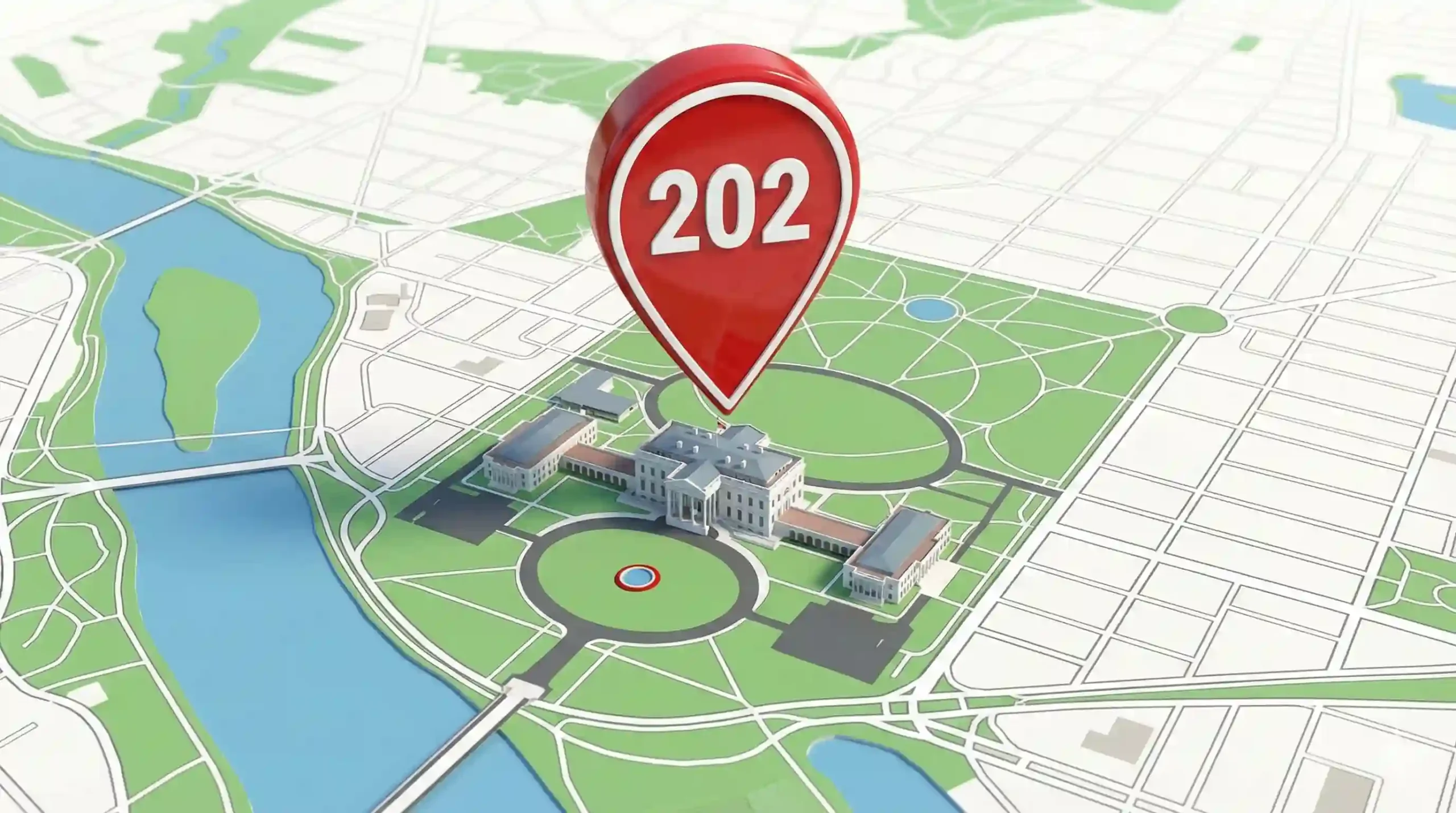
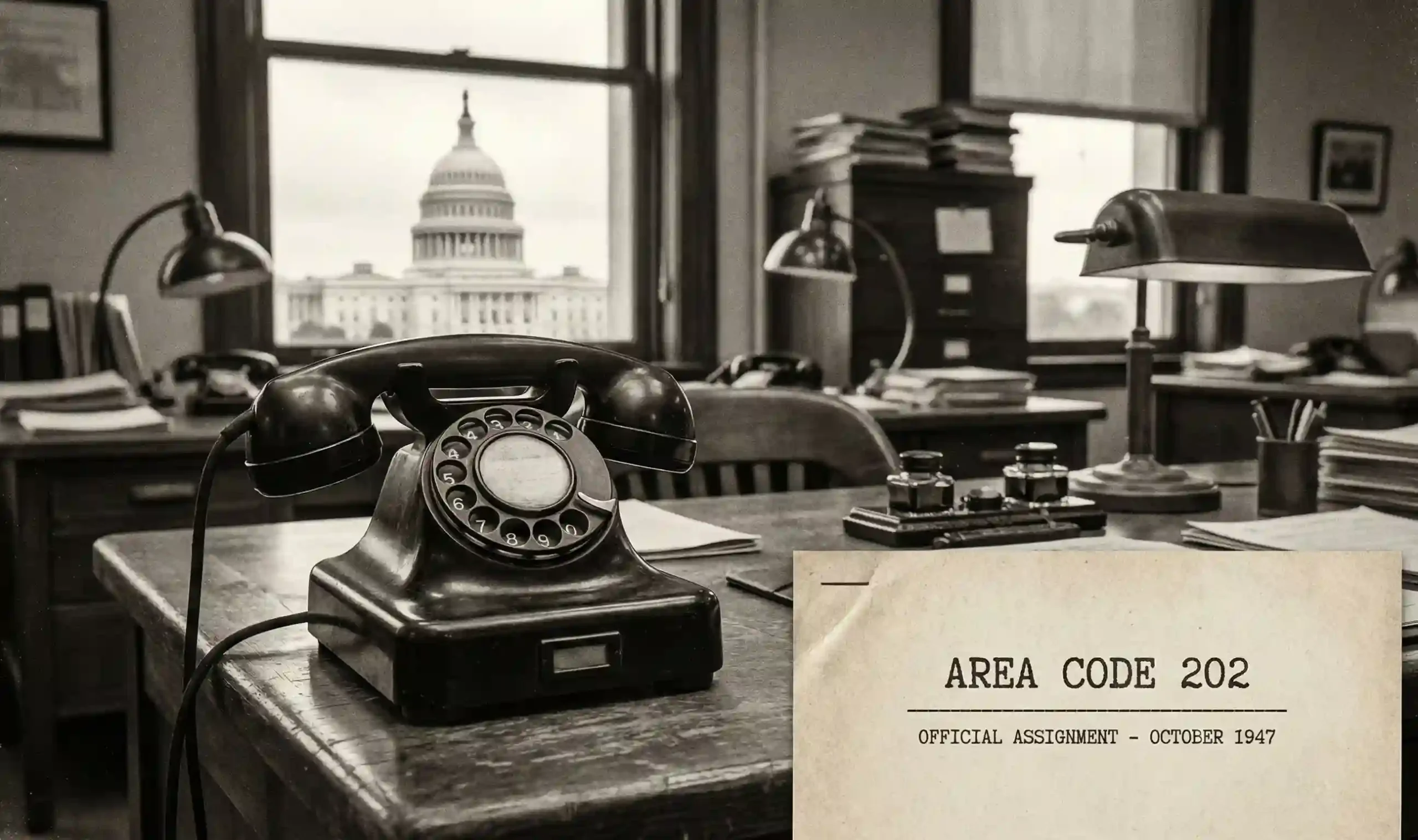
The 202 area code is the primary telephone code for Washington, D.C., the capital of the United States, and one of the most recognizable and prestigious area codes in the world. Established on 01/01/1947 as one of the original North American Numbering Plan (NANP) codes, the 202 area code now works in an overlay with the newer 771 area code and follows a modern 10‑digit dialing plan in the Eastern Time Zone.
What Is the 202 Area Code?
The 202 area code is the official geographic telephone area code for the District of Columbia (DC), serving the entire city that houses the White House, Congress, the Supreme Court, and most major federal agencies. DC is a federal district, not a state, and 202 is unique in that it represents the U.S. capital itself rather than any U.S. state.
Key facts:
-
Location: District of Columbia (Washington, DC).
-
Country: United States (US).
-
Time Zone: Eastern Time (E), the same as New York and much of the U.S. East Coast.
-
In‑service date: 01/01/1947, making 202 one of the original NANP area codes.
-
Overlay complex: 202/771, with 771 added as the new overlay to provide additional numbers.
Because 202 is so closely associated with federal government offices, it carries an aura of authority and prestige, which is also why it is heavily targeted for spoofing by scammers.
Geography & Coverage of the 202 Area Code
Entire District of Columbia
The 202 area code covers all of Washington, D.C., including:
-
The White House
-
The U.S. Capitol and congressional office buildings
-
The Supreme Court and major federal judicial buildings
-
Federal agency headquarters (IRS, FBI HQ in DC metro context, SSA offices, etc.)
-
Washington monuments, museums, and central business districts
-
Residential neighborhoods across the entire District
If a number has a 202 or 771 area code, its registered “home” region is Washington, D.C., not any of the surrounding suburbs.
Not Maryland or Virginia
A crucial distinction for callers:
-
202/771 = District of Columbia only.
-
Surrounding Maryland suburbs (e.g., Bethesda, Silver Spring) use codes such as 301, 240, 227.
-
Northern Virginia suburbs (e.g., Arlington, Alexandria) primarily use 703 and 571.
This means a call from 202 or 771 is from a DC‑based number, while calls from 301/240/227 or 703/571 are from the metro suburbs in Maryland or Virginia, not the District itself.
The 202/771 Overlay: Why 771 Was Added
Why a new overlay was needed
Demand for phone numbers in Washington, DC grew steadily due to:
-
Increased mobile phone use
-
VoIP and business lines
-
Growth in government contractors, nonprofits, and tech firms
By the late 2010s, forecasts showed 202 would run out of assignable numbers, triggering NANPA’s relief process. To prevent exhaustion, regulators approved an all‑services overlay, adding area code 771 on top of the existing 202 territory.
Planning Letter 547 (PL‑547) is the official NANPA document describing the 202/771 all‑services overlay for the District of Columbia, including timing, dialing changes, and customer impact. Citing PL‑547 in technical or regulatory contexts reinforces the authority of your information when discussing the overlay.
What the 771 overlay means in practice
Key points about 771:
-
Same geography: 771 covers the exact same area as 202—i.e., the entire District of Columbia.
-
No number changes: Existing 202 numbers were not changed; customers kept their area code and 7‑digit number.
-
New codes for new lines: New phone lines and services in DC can be assigned 771 if 202 blocks are exhausted, or according to carrier allocation.
-
Local equivalence: A call from 771 is just as local as a call from 202—both are DC area numbers, and rating/billing treat them as local in the same way.
For residents and businesses, the biggest visible change was the requirement to dial 10 digits (or sometimes 1+10 digits) for local calls, rather than 7 digits.
Dialing Rules for the 202 Area Code (Technical Guide)
With the 202/771 overlay, the dialing plan follows modern NANP rules for dense metro overlays.
10-digit dialing for local calls
The standard dialing method for local calls inside the home NPA (202/771) is:
-
10D – Area Code + 7‑digit number.
This applies to:
-
Calls between two 202 numbers in DC
-
Calls between a 202 and a 771 number
-
Calls between two 771 numbers
In other words, for a local DC call, you dial something like:
-
202-XXX-XXXXor771-XXX-XXXX(no leading “1” required by default from mobiles and many VoIP services).
Foreign NPA local calls: Also 10D
The NANPA dialing logic and overlay implementation also support 10‑digit dialing for foreign NPA local calls—calls to nearby area codes that are still rated as local, such as certain nearby Maryland or Virginia numbers. In these cases, you still use Area Code + Number when dialing.
The “1+10D permissible” note explained
A key note associated with overlay dialing plans states that “1+10 digit [is] permissible at each service provider’s discretion.” This means:
-
Required standard: 10‑digit dialing (area code + number) is mandatory as the base standard for local calls in the 202/771 area.
-
Permissive behavior: Some landline or VoIP providers may also allow you to dial 1 + area code + number (11 digits) for local calls—essentially mimicking long‑distance dialing format even when the call is local.
-
Carrier‑specific: Whether you can use 1+10D for local calls depends entirely on your service provider’s configuration and local regulatory rules.
Practical examples:
-
On many mobile phones, you can dial either
202-XXX-XXXXor1-202-XXX-XXXX, and both will complete. -
On some landlines, you may be required to dial
1-202-XXX-XXXXfor certain calls, while others complete with just 10 digits.
The NANPA guidance gives carriers flexibility, but for users the safe rule in DC is: Always include the area code (202 or 771); use “1” only if your provider expects it.
Government Imposter Scam Risk: Why 202 Calls Demand Caution
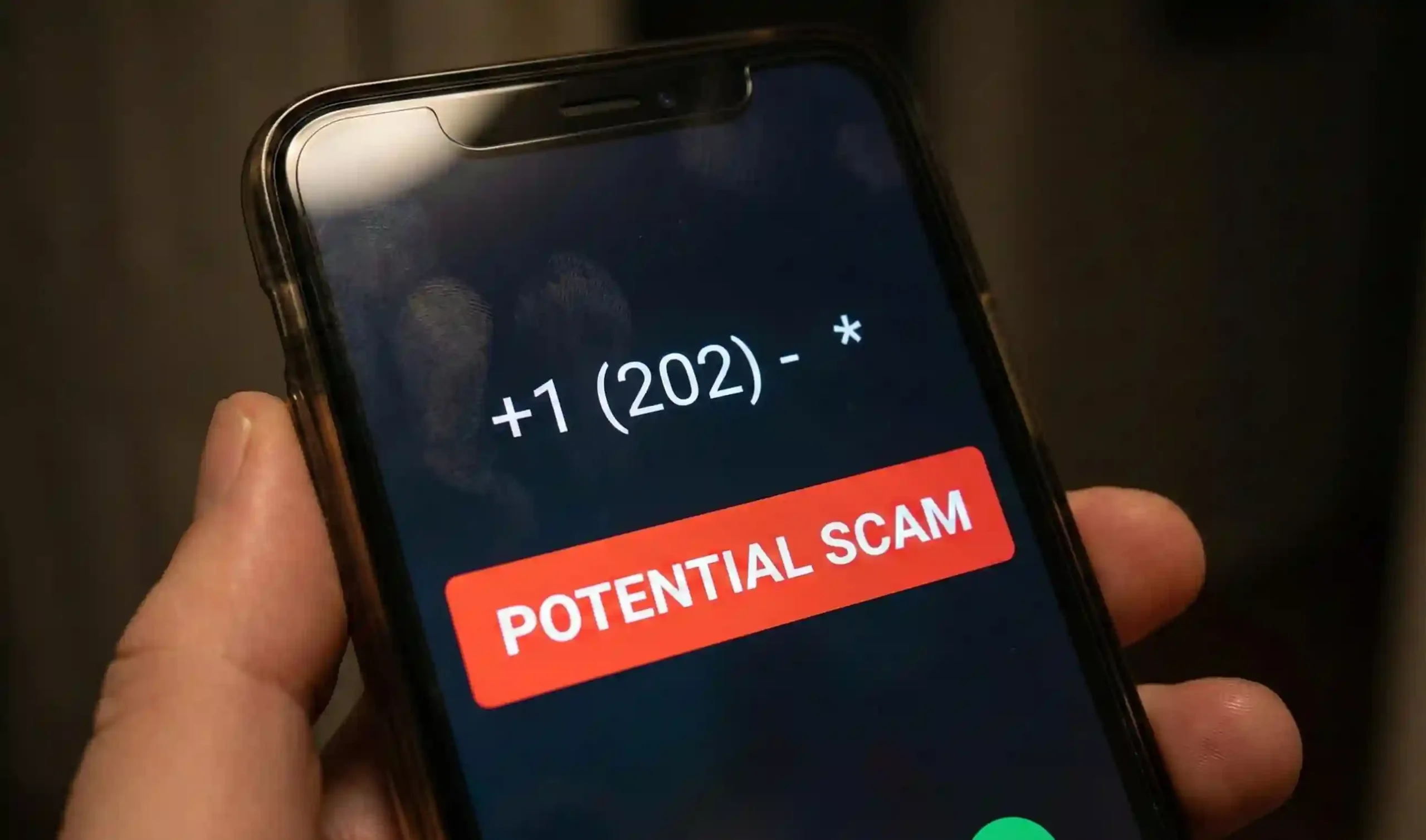
Because 202 is so closely associated with federal agencies (FTC, IRS, Social Security Administration, FBI, Medicare, etc.), scammers heavily exploit it for “government imposter” scams.
How scammers spoof 202 to look official
Scammers use VoIP tools to spoof caller ID, making their calls appear to originate from real 202 numbers used by agencies or DC‑based offices. A typical scenario:
-
Your phone shows a call from a 202 number with a label like “IRS,” “Social Security,” or “Federal Bureau.”
-
If you look up the number online, it might correspond to a genuine agency line, because scammers often spoof actual published government numbers.
-
The caller then claims you owe money, your Social Security number is compromised, or you’re in legal trouble unless you act immediately.
The FTC warns that these calls are classic government impersonation scams and that caller ID, including the 202 area code and even real agency names, can be faked.
Red flags for fake 202 government calls
Be extremely cautious if a 202 (or 771) caller:
-
Demands immediate payment via gift cards, wire transfer, cryptocurrency, or prepaid debit cards.
-
Threatens arrest, deportation, license revocation, or legal charges if you do not pay at once.
-
Asks you to verify personal data (Social Security number, full bank details, login credentials).
-
Tells you not to hang up or not to speak to anyone else about the call.
Real U.S. government agencies:
-
Do not demand payment by gift card, wire, or crypto.
-
Do not threaten immediate arrest over the phone.
-
Typically contact you first by official mail and provide clear, verifiable contact info.
How to verify if a 202 call is actually from the government
To protect yourself:
-
Don’t trust caller ID alone. Treat any unsolicited 202 call claiming to be an agency as suspicious. Caller ID can be spoofed.
-
Hang up and verify independently. If the caller claims to be from IRS, SSA, Medicare, FBI, etc., end the call and look up the official agency number on .gov websites. Call them back using that verified number—not the one that called you or any number the caller gives you.
-
Check your mail and online account. Agencies like the IRS send letters and provide secure online accounts. If there is a genuine issue, it should appear in your official correspondence or online portal.
-
Report scams. You can file complaints about government impersonation calls with the FTC, the appropriate inspector general (e.g., SSA OIG), or your state attorney general’s office.
Remember: Seeing a 202 area code does not prove the call is from the U.S. government. It only indicates that the number appears to originate from the DC region—and that too can be faked.
Quick Facts Table: 202 Area Code at a Glance
| Attribute | Detail |
|---|---|
| NPA (Area Code) | 202 (overlayed by 771) |
| Location | District of Columbia (Washington, DC – U.S. capital, not a state) |
| Geographic Scope | Entire District of Columbia (no Maryland or Virginia suburbs) |
| Time Zone | Eastern Time (E) |
| Overlay Code | 771 – new all‑services overlay for 202 |
| In‑Service Date | 01/01/1947 – one of the original NANP area codes |
| Planning Letter | NANPA Planning Letter 547 (PL‑547) – governs 202/771 overlay implementation |
FAQ: 202 Area Code and 771 Overlay
Is 202 a toll‑free number?
No. The 202 area code is not toll‑free. It is a geographic area code for Washington, D.C. Toll‑free area codes in the U.S. include 800, 888, 877, 866, 855, 844, 833, and 822, not 202. Calls to 202 (or 771) are billed according to your carrier’s plan and your calling location.
Why did I get a call from the 202 area code?
You might receive a call from 202 (or 771) because:
-
A legitimate Washington, DC business or resident is calling you.
-
A federal agency office or DC‑based organization is contacting you.
-
A scammer is spoofing a 202 number to impersonate the government or a DC institution.
If the caller claims to be from a government agency, is pressuring you for immediate payment, or asks for sensitive information, treat it as a potential government imposter scam and verify independently before doing anything.
Is 771 the same as 202?
Functionally, yes for location and local dialing:
-
Both 202 and 771 cover the exact same geographic area—the District of Columbia.
-
Both codes are part of the same overlay complex (202/771) and are rated as local to each other.
-
A call from a 771 number is just as “Washington DC local” as a call from 202.
The only difference is that 202 is the original area code, while 771 is the newer overlay introduced to supply additional numbers as described in Planning Letter 547.
Do I have to change my 202 number because of 771?
No. Existing 202 customers did not have to change their numbers when 771 was added. The overlay model allows both area codes to coexist over the same territory, with 202 numbers kept intact and 771 assigned mainly to new lines.
Do I always need to dial the area code when calling within DC?
Yes. With the 202/771 overlay and the shift to 10‑digit dialing:
-
You must dial area code + number for all local calls within DC (e.g., 202‑XXX‑XXXX or 771‑XXX‑XXXX).
-
Some carriers may also allow 1+10 digits (1‑202‑XXX‑XXXX) for local calls at their discretion, but including the area code is no longer optional.
How can I get a 202 or 771 number?
You can obtain a DC number via:
-
Mobile carriers: When activating service in the Washington, DC area, you can request a 202 or 771 number, subject to availability.
-
VoIP and virtual phone providers: Many business VoIP platforms offer 202/771 numbers for a DC presence.
-
Number marketplaces: Some services sell or broker “vanity” 202 numbers, which may come at a premium.
For branding and prestige, some organizations specifically seek 202 numbers because of their strong association with the U.S. capital and federal government.
By understanding how the 202 area code and its 771 overlay work—where they apply, how dialing rules function, and how scammers misuse them—you can confidently handle calls from Washington, DC while staying alert to government impersonation scams.